

 Vendor Portal

Author: Mark Ainely | Partner GC Realty & Development & Co-Host Straight Up Chicago Investor Podcast
Chicagoland real estate investors, how long should it take to handle maintenance on your rental properties? Between operating GC Realty & Development and connecting with listeners from the Straight Up Chicago Investor Podcast, maintenance is one of the topics we come back to most. And for good reason. How an investor handles routine and seasonal maintenance sets the tone for how successful those investments will be.
Rental Unit Maintenance In Chicago
How long should a maintenance work order take to complete? For landlords managing a single unit in Schaumburg, house hacking a three flat in Ukrainian Village, or running a larger apartment building in Rogers Park, that question carries real financial weight. Every day a repair sits unresolved adds friction to the resident experience and, over enough instances, contributes to turnover decisions that cost thousands per unit.
This ongoing conversation got me interested in how GC Realty & Development actually performs. I have always had the feeling we do a good job, but will the data tell the same story?
This analysis draws from 12 months of maintenance data collected between February 2025 and January 2026 across a portfolio of approximately 1,400 rental units in the Chicagoland area. The dataset captures median days between work order creation and completion across 13 distinct trade categories. All figures represent median values rather than averages, providing a more accurate picture of typical performance by reducing the influence of outlier situations such as insurance claims or capital projects. The portfolio includes single family homes, multi unit buildings, and condominiums across Chicago and its surrounding suburbs.
Completion Times by Category: Trade by Trade
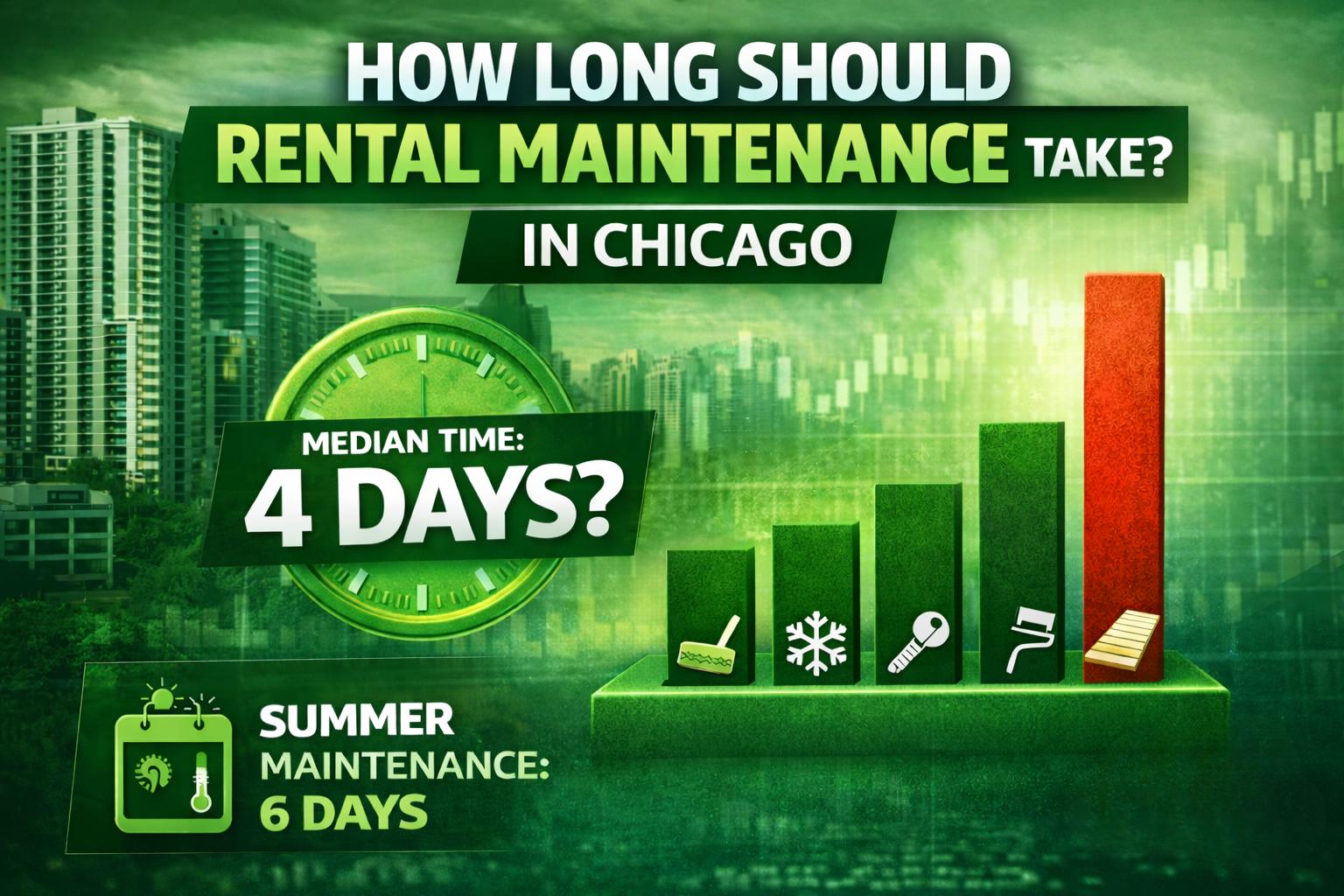
The overall median completion time across all maintenance categories during this 12 month period was four days. To put that in perspective, most self managing landlords we talk to on the podcast estimate their typical work order takes one to three weeks from the time a resident reports an issue to the time it is fully resolved. That four day median includes every category in our portfolio, from same day lockouts to multi week flooring installs. However, that single number masks significant variation between trade categories. The table below presents the complete breakdown.
Maintenance Category | Median Days to Complete | Primary Factor |
Cleaning | 2 | Same-day to next-day |
HVAC | 2 | Emergency priority |
Locksmith | 2 | Emergency priority |
Plumbing | 3 | Routine scheduling |
Specialty | 3 | Varies by trade |
Electrical | 4 | Standard scheduling |
Exterior | 5 | Weather dependent |
General Handyman | 5 | Multi-task coordination |
Appliances | 6 | Parts sourcing delays |
General Contractor | 6 | Scope-dependent |
Pest Control | 7 | Treatment cycles |
Painting | 8 | Multi-day scope |
Flooring | 14 | Vendor lead times + install |
Three categories stand out as notably fast. Cleaning, HVAC, and locksmith work each reached a median of two days. HVAC and locksmith repairs carry inherent urgency, while cleaning often involves turnover work on defined timelines tied to move-in dates.
The middle tier, spanning plumbing through general contractor work at three to six days, represents the bulk of routine maintenance. These categories involve standard vendor scheduling, parts availability, and scope assessment following predictable workflows.
Why Painting and Flooring Are Outliers
Painting at eight days and flooring at 14 days sit well above the portfolio median, and the reasons are structural rather than operational. Painting projects require multiple visits for preparation, priming, and finish coats, with drying time between stages. When a turnover requires full-apartment painting, the timeline extends further as painters coordinate with cleaning and other trades.
Flooring at 14 days is the longest median in the dataset. This category involves material lead times other trades do not face. Ordering materials, scheduling multi-day installation, and coordinating around resident occupancy all contribute. Flooring also showed the widest monthly variation, ranging from six days in May 2025 to 19 days in July 2025, suggesting summer turnover volume compounds baseline scheduling challenges.
Seasonal Patterns in Completion Times
The data reveals a clear seasonal pattern that Chicago landlords should anticipate when planning their maintenance operations.
Period | Median Completion Time | Context |
Feb – May (Winter/Spring) | 3 – 4 days | Lower demand period |
Jun (Early Summer) | 4 days | Transition period |
Jul – Aug (Peak Summer) | 6 days | Highest demand |
Sep – Nov (Fall) | 5 days | Turnover season |
Dec – Jan (Winter) | 4 days | Stabilized demand |
The jump from three to four days in spring to six days at peak summer represents a 50 to 100 percent increase in completion timelines. Summer is peak leasing and turnover season in Chicago, creating demand surges that stretch vendor capacity market-wide. Landlords managing their own properties should expect summer work orders to take meaningfully longer, particularly for turnover-related work.
July is typically the largest month for tenants moving out on June 30th in our portfolio so I can see how our vendors might take longer times but we could clearly work on that if we saw it to be a problem by adding resources.
The Vendor Relationship Factor: What Drives Completion Speed
One of the most significant variables in maintenance completion time is the difference between established vendor relationships and ad hoc vendor sourcing. For a landlord managing a handful of units, addressing a maintenance issue typically involves identifying the problem, researching vendors, collecting bids, scheduling work, and following up on completion. Each step adds time.
Consider the practical differences. A property management operation processing hundreds of work orders monthly maintains vendor relationships across every trade. When an HVAC issue arises, dispatch happens within hours because pricing and scheduling channels are already established. The two-day median HVAC time in this dataset reflects that infrastructure.
A self-managing landlord facing the same issue may spend a day or more identifying a qualified technician and confirming pricing before work begins. That vendor selection process alone can add two to four days to a straightforward repair. Across a year of maintenance events, those additional days compound into weeks of delay.
In-House Response vs. External Coordination
The data also highlights the advantage of in-house maintenance staff for initial response and triage. General handyman work, covering a broad range of minor repairs, shows a five-day median. Within a managed portfolio, many of these orders are addressed by staff technicians within 24 to 48 hours, with the five-day median reflecting the full spectrum including complex tasks requiring return visits or parts.
For landlords without dedicated maintenance personnel, the same work requires scheduling an outside handyman, introducing availability gaps. A reliable handyman in Chicago may have a booking window of three to seven days during busy periods, meaning repair work does not start until nearly a week after the request. The difference between on-call maintenance staff and external scheduling is often the difference between a two-day resolution and a two-week resolution.
Additional Data Patterns Worth Noting
Several additional observations from the dataset provide useful benchmarking context.
Pest control at seven days median reflects that effective treatment often requires multiple visits. Initial treatment followed by inspection and possible re-treatment extends the timeline beyond single-visit repairs. A seven-day pest control timeline is not a sign of poor responsiveness but rather appropriate treatment protocol.
Appliance repairs at six days frequently involve parts ordering. A technician may diagnose the issue on day one, but if a specific part must be ordered, the completion clock continues until it arrives and is installed. Having vendor accounts with parts distributors provides a measurable advantage over retail ordering.
Electrical work at four days is notably efficient given that many electrical repairs require licensed electricians with constrained availability. This figure suggests that maintaining a reliable electrician relationship is one of the highest-value vendor partnerships a landlord can establish.
What the Data Tells Chicago Landlords
The central finding from this dataset is that maintenance completion timelines are driven by three primary factors: the inherent nature of the work, seasonal demand patterns, and the operational infrastructure behind vendor coordination.
For landlords evaluating their own performance, this data provides concrete benchmarks. If routine plumbing repairs consistently take more than a week, that suggests a vendor access problem rather than a complexity problem. If summer turnovers create extended vacancies, the seasonal data confirms that proactive scheduling before peak season is necessary.
The most actionable insight may be the simplest: the gap between a two-day emergency repair and a two-week delayed response usually is not about the repair itself. It is about the systems, relationships, and processes that exist before the work order is ever created. Whether a landlord builds those systems independently or leverages existing infrastructure, the data makes clear that maintenance speed is primarily an operational question, not a technical one.
Don’t Go At This Alone
This is a lot of information you need to know if you plan to invest here in the Chicago market and it may seem overwhelming but real estate investing in Chicago is a team sport. Who is on your real estate investing team? Do you have a team? GC Realty & Development has a team of resources and we are willing to share all of our 20+ years of experience in both real estate investing and Property Management in the Chicago market. We will do this whether you hire us or not.
What gets me up in the morning and keeps me going 12+ hours a day of work is the ability to add value to Chicago real estate investors. If we connect you will here my say our goal of our company is to have value to have everyone we come in contact with and in return we hope one day you will hire us for our Tenant Placement or Property Management Services You can also refer us to someone you know that needs Tenant Placement or Property Management Services, or I will take a simple 5 Star Google review. We love the opportunity when we get all three from current and aspiring investors we get to help!
Reach out today!

Partner / Co-Host of Straight Up Chicago Investor Podcast