

 Vendor Portal

Author: Mark Ainely | Partner GC Realty & Development & Co-Host Straight Up Chicago Investor Podcast
Every landlord has been here. You get the call that something's broken in one of your units. Your first instinct is to send a repair tech out to take a look. But here's the problem with that approach: the repair or replace decision really needs to happen before you dispatch anyone. Because once that tech shows up, you're paying a trip charge, a diagnostic fee, or both. That's $75 to $150 before a single thing gets fixed. If you then decide the appliance should be replaced instead of repaired, that money is gone.
So how do you make that call without a tech on site? With data. We tracked 1,552 appliance work orders across our 1,400+ unit portfolio over the last two years, and now we know what the average repair costs for every major appliance, how often those repairs actually stick, and at what point you're better off just buying new. If you know the age of the appliance and what type it is, you can make a smart decision before anyone gets in a truck.
The Average Repair Costs 40% of a Replacement
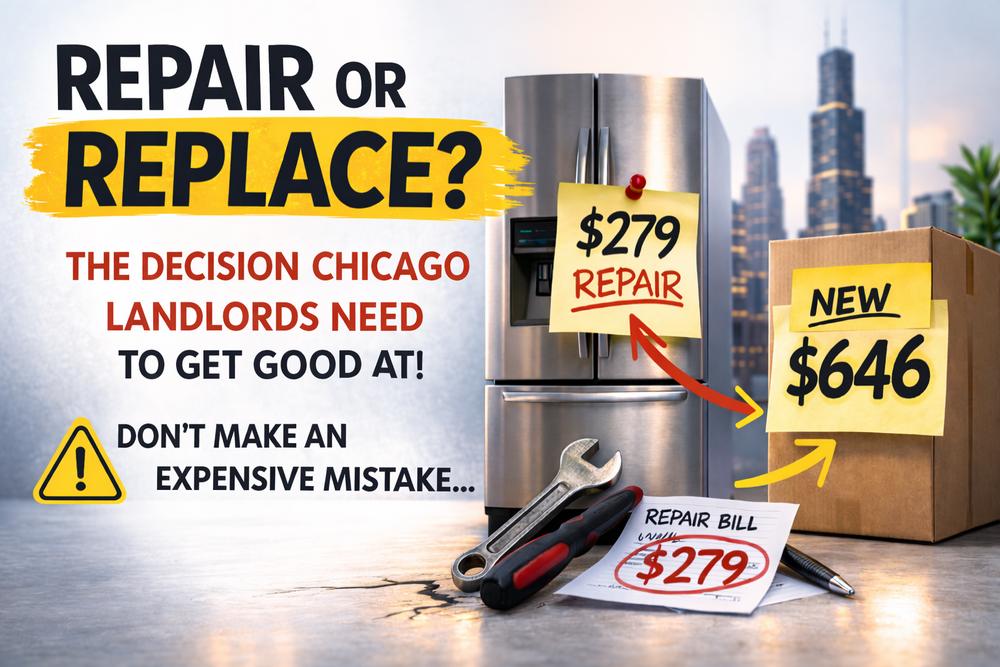
That's the starting point. Across our entire portfolio, the average appliance repair runs $279 and the average replacement runs $646. So on average, a repair costs about 43% of what a full replacement would. That means most of the time, repairing makes financial sense. And the data backs that up: 76% of our appliance work orders over the last two years were repairs.
But averages don't tell the whole story. The repair or replace math changes dramatically depending on which appliance you're talking about.
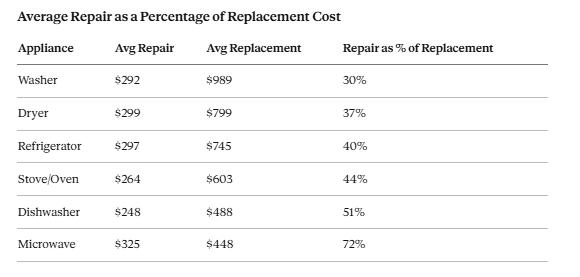
Look at the spread. A washer repair costs 30% of a replacement on average. That's a clear repair situation most of the time. But a dishwasher repair is already at 51% of replacement cost, and a microwave repair is at 72%. When the repair is approaching the cost of a brand new unit, the math starts telling you something.
The Microwave Is Almost Always a Replace
I talked about this in our last article, but it's worth repeating because it's the clearest example in the data. 74% of microwave repairs in our portfolio exceeded 50% of the average replacement cost. The average microwave repair was $325. A company like Abt in Glenview can install a brand new over the range microwave for around $425 all in. You're paying 72 cents on the dollar to keep an aging unit alive when a new one with a manufacturer warranty is barely more.
Unless the issue is something dead simple like a broken handle where you can order the part yourself, just replace the microwave. Our data shows 38% of microwave work orders ended in replacement anyway, the highest rate of any appliance, because vendors are looking at these units and telling owners the same thing.
The "Repair Twice, Replace Anyway" Trap
Here's where the data gets really interesting. We found 119 situations in our portfolio where the same appliance at the same property was repaired two or more times over the two year period. The average total cost across those repeat repair situations was $761.
And here's the number that should make every investor pay attention: 28 of those 119 situations eventually ended in a full replacement anyway. Those owners paid for multiple repairs and then still had to buy a new appliance on top of it.
Think about that. You pay $250 for a repair, then six months later you pay another $280 when something else goes on the same unit, and then three months after that the vendor tells you the compressor is shot and you're looking at a $745 replacement. You've now spent over $1,275 on an appliance you could have replaced for $745 after that first repair if you had known the age and condition of the unit.
This is the most expensive mistake we see landlords make. Not the decision to repair. The decision to keep repairing without factoring in the age and history of the appliance.
The Decision Framework: Three Questions
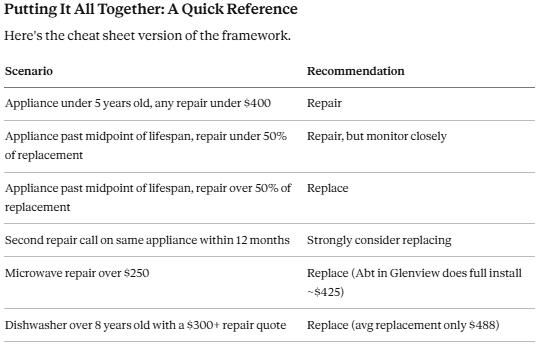
After looking at 1,552 work orders, here's the framework we use at GC Realty when a repair or replace decision hits our desk. It comes down to three questions.
Question 1: How old is the appliance?
This is the most important question and the one most landlords skip because they don't know the answer. Here's what you should be working with for rental property lifespans.
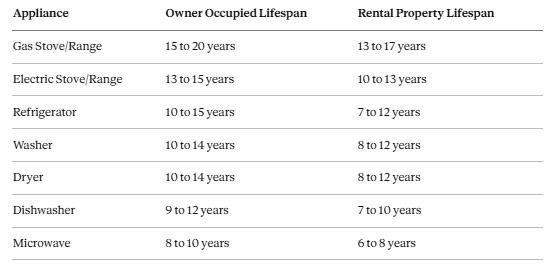
These lifespans differ because rental appliances take more wear. Multiple tenants cycling through, heavier daily use, and less preventive maintenance all shorten the clock. If you live in your property and rent out part of it, your actual lifespan may fall somewhere between these two columns depending on how the units are used.
If the appliance is past the halfway point of its expected lifespan, you need to weigh the repair a lot more carefully. A repair on a 4 year old refrigerator is almost always worth it. A repair on a 10 year old refrigerator might be throwing good money after bad.
Landlord Tip: Not sure how old the appliances are? Go to homespy.io and punch in the brand and serial number. It decodes the manufacture date in about 30 seconds. The serial number is usually on a sticker inside the door, on the back of the unit, or under a removable panel. This should be step one before you approve any repair over $200. Knowing the age changes the entire decision.
Question 2: What does the repair cost relative to replacement?
Here's a simple rule that holds up well against our data. If the repair costs more than 50% of what a new appliance would cost AND the appliance is past the midpoint of its expected lifespan, replace it. Don't repair it.
Here's how often repairs in our data crossed that 50% threshold by appliance.
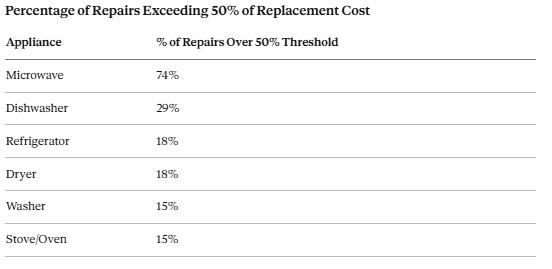
Microwaves blow past the threshold almost every time. Dishwashers cross it nearly a third of the time. For fridges, dryers, washers, and stoves, the majority of repairs stay well below the threshold, which is why those appliances have repair rates of 73% and higher in our data. Most of the time, repairing them is the right call.
Question 3: Is this a repeat visit?
If a vendor has already been out to repair the same appliance in the last 12 months, that changes the calculus significantly. Our data showed that repeat repair situations averaged $761 in total cost, and nearly a quarter of them ended in replacement anyway. A second repair call on the same appliance should trigger a serious conversation about whether it's time to move on, especially if the appliance is more than halfway through its expected lifespan.
Don't Go at This Alone
Look, I get it. A lot of investors try to manage maintenance issues themselves. They're Googling model numbers at 10 PM, calling around for quotes, and trying to figure out if it's worth fixing a 9 year old dishwasher. I've been doing this for 23 years and I still rely on the vendor relationships and systems we've built at GC Realty to make these calls efficiently.
This is exactly the kind of thing a good property manager handles for you. We know which appliances to repair and which ones to replace. We have the vendor relationships to get competitive pricing. We track every single work order so we can show you exactly where your money is going, just like we did in this article.
If you're self managing and this data made you realize you don't have a handle on your appliance costs, or if your current property manager can't produce numbers like these, that's worth a conversation. Reach out to us at GC Realty & Development and let's talk about what your portfolio actually looks like under the hood.
Whether you are a first time investor or a seasoned pro, having the right team behind you makes all the difference. If you want a data backed rent analysis for your Chicago area investment property, reach out to us at gcrealty.com or give us a call. We’ll show you what the market says your property is worth and help you lease it fast.
Reach out today!

Partner / Co-Host of Straight Up Chicago Investor Podcast
Mark Ainley is the owner and managing partner of GC Realty & Development, LLC, Chicago's Responsive Property Manager®, managing 1,400+ units across the Chicagoland area. He is also the co-host of the Straight Up Chicago Investor podcast.