

 Vendor Portal

Author: Mark Ainely | Partner GC Realty & Development & Co-Host Straight Up Chicago Investor Podcast
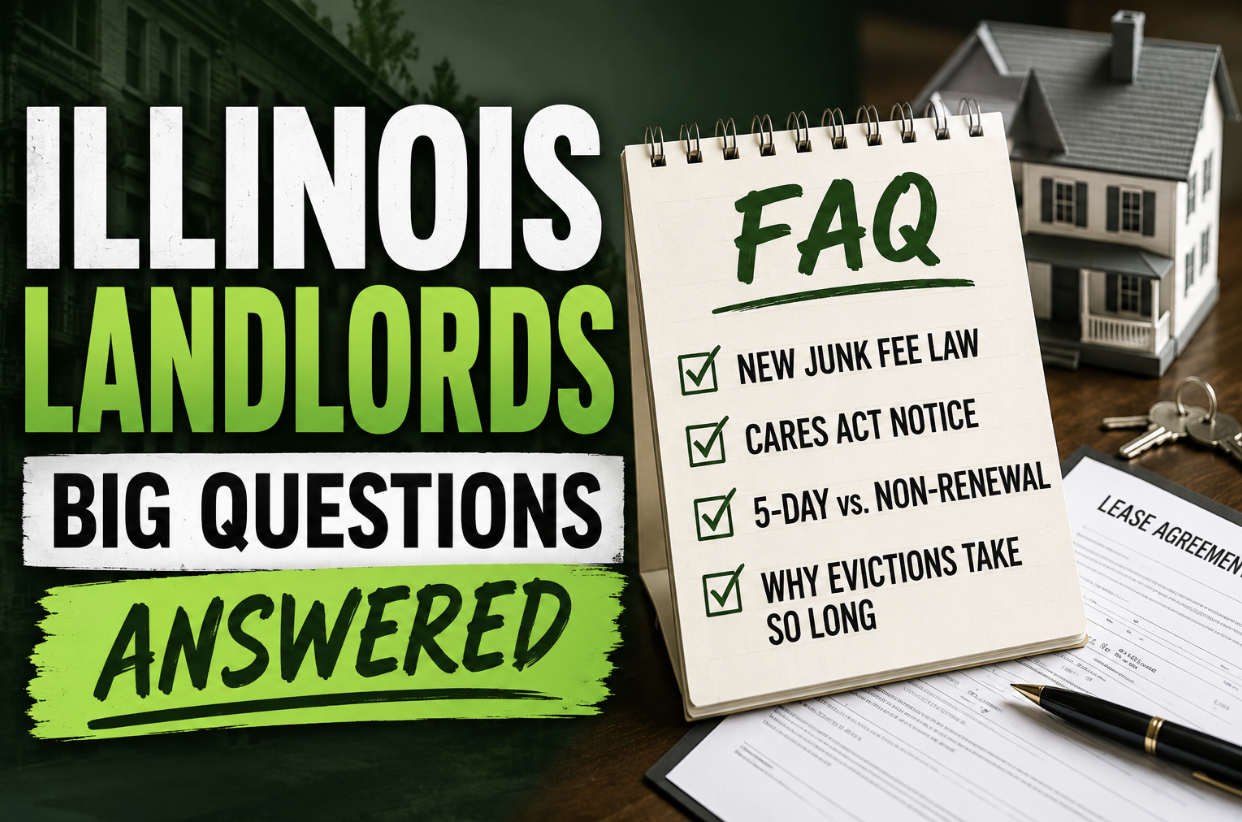
As a property manager working with Chicago landlords every day, and co-host of Straight Up Chicago Investor, I hear the same questions come up again and again. If one investor is asking, plenty of others are wondering the same thing. So I put together the topics I find myself discussing most with landlords and rental property owners right now: the new Illinois junk fee statute, the CARES Act 30-day notice, when to choose a 5-day over a non-renewal, and the one I get on almost every call. Why is my eviction taking this long?
Real questions from owners and managers, with short answers you can act on.
The New Illinois "Junk Fee" Statute
What is the new junk fee statute?
It is an amendment to the Illinois Landlord Tenant Act (new Section 35), signed April 8, 2025. It applies to every rental property in Illinois, not just Chicago, not just Cook County.
Two parts:
Fee disclosures required in the listing and on the first page of the lease.
A ban on specific "junk fees" the statute lists by name.
Effective date: currently July 1, 2025, but a trailer bill moving it to January 1, 2026 has cleared the Senate and is expected to pass. For the full breakdown, see our deep dive on HB 3564 and what Illinois landlords need to know.
Does it apply to my building?
Yes, with one narrow exception.
Exempt: owner-occupied properties with 6 or fewer units. Live on the first floor of your 3-flat? You are out.
Covered: every other rental in Illinois, including non-owner-occupied 3-flats and any building with on-site management.
What fees do I have to disclose, and where?
All non-optional (mandatory) fees. One-time and monthly recurring.
They have to appear in two places:
The listing (or a web link directly from the listing).
The first page of the lease.
Penalty for missing a disclosure: the tenant does not have to pay that fee. Disclose utilities too. If only some are included in rent, list which ones. Our walkthrough of the full 2026 law changes covers every operational shift this triggers.
How do I fit fee disclosures on page 1 when the Safer Homes summary already takes pages 1 through 4?
Springfield and Chicago do not always talk to each other. Here is the cleanest compliance path:
Keep the Safer Homes Summary of Rights as pages 1 through 4 of the lease packet.
Put the non-optional fee disclosure as a box on the first page of the actual lease (physically page 5 of the packet, but page 1 of the lease itself).
If you ever get sued, you can hand the judge the lease and point to page one. The Blue Moon / NAA lease is being updated to handle this automatically. For more on the Safer Homes piece, read Safer Homes and Smarter Leases.
Is the application fee capped?
Yes. $50, including the background check cost. You can charge more, but only by meeting three strict criteria with receipts and tenant disclosures. For most operators it is not worth the workflow burden. Cap at $50 and move on.
What about admin fees and move-in fees taken with the application?
Any fee collected at the time of application in addition to the application fee is banned.
Fix:
Move-in fees: collect at lease signing, after approval, not at application.
Admin fees: push to lease signing and make sure the amount reasonably relates to your actual costs (staff time, materials, overhead).
Can I still charge a unit transfer fee?
Depends on how you paper it.
Addendum to the existing lease changing the unit number: that is a modification. Fee banned.
Brand new lease for the new unit: not a modification, not a renewal. Fee is allowed.
Action: always write a new lease when a tenant transfers units in your building. Same logic applies to adding or removing a roommate. New lease, new fee permitted.
Can I still charge for cleaning and painting at turnover?
No. Routine turn costs, one coat of paint and standard cleaning, are the cost of owning rental property. You can still charge a tenant for damage beyond normal wear and tear. Big difference.
What fees are explicitly banned?
Modification or renewal of a lease (plain renewals. See next question on the workaround).
Eviction-related costs charged to the ledger before a court grants the eviction order.
After-hours maintenance request fees.
Contacting the landlord or management about maintenance, lease questions, or anything tenancy-related.
Travel to complete maintenance or safety repairs.
Maintenance hotline fees.
Routine maintenance, upkeep, cleaning, and painting.
Still allowed: lockout fees. That is tenant negligence, not a maintenance request.
What if I want to charge a fee at lease renewal, is there a way?
If you issue a brand new lease for the next term (not an addendum), the statute does not ban a fee. But there is risk. Chicago and Cook County require you to send a notice of renewal using that word. A tenants’ rights attorney could argue your intent was a renewal. Path of least risk: do not charge a fee on lease renewals, even when you paper it as a new lease.
What happens if I get this wrong?
Tenants can sue for:
Injunctive relief, a court order making you stop charging the fee.
Monetary relief, refund of the fees they paid.
Attorney’s fees and court costs.
The real exposure is class actions. One tenant is a small hit. Three years of undisclosed fees across every tenant in the building, plus class action attorney’s fees, is a different conversation. There are also the 2025 Landlord Retaliation Act rules to keep in mind if you respond to a tenant complaint about fees. Comply.
The CARES Act 30-Day Notice
Is the CARES Act 30-day notice still required?
It is still on the books. Fannie Mae and Freddie Mac announced in October 2024 they will no longer enforce the CARES Act requirements against their mortgagors.
Practical answer: if your loan is Fannie or Freddie, you can go back to a standard 5-day notice (10-day in Evanston). Full background on when each notice applies is in our guide to 5-Day vs. 30-Day Notice of Non-Payment.
What is the risk of going back to a 5-day?
The CARES Act has not been repealed. A judge could still enforce it and dismiss your case, forcing you to start over with a 30-day notice. The argument that Fannie and Freddie no longer enforce it is strong, but it is not guaranteed to win in front of every judge.
Who still needs to use the 30-day notice?
Properties with other federal funding (VA loan, FHA loan).
Tenants receiving federal subsidies, Section 8, CHA, any housing authority voucher.
Buildings under federal affordable housing programs.
HUD update: HUD proposed revoking the CARES Act requirements for federal subsidies in February 2025. Public comment closed April 27. The final rule has not landed yet, so confirm where things stand before adjusting your notice practice on a subsidized tenant.
5-Day Notice vs. Non-Renewal
Tenant is delinquent and the lease is almost up. 5-day or non-renewal?
No single right answer. The question is what you are optimizing for: speed, money judgment, or insulating yourself from liability. Here is the breakdown.
When to serve a 5-day notice
You want a money judgment. Eviction court gives you garnishment and bank account freezes.
You are in DuPage, Will, or Lake. You can often get an eviction order on the first court date and be out in under 70 days.
The tenant is a known player. Stubborn, non-responsive, has worked the system before. Get the case on file now.
Con: in Chicago and Cook, the tenant has a one-time right to pay and stay during the eviction. If your real goal is getting them out, that is a meaningful risk.
When to serve a non-renewal
You just want them out and are willing to write off the back rent.
The tenant is a rule-follower who lost their job and is likely to leave at the lease end date.
You are in Chicago or Cook and want to avoid a 6-month ERP process.
Recovery path: after they move out, send the balance to a collection agency or file a breach of contract suit for a money judgment. Our overview of the Illinois eviction process and your legal options walks through both routes end to end.
Notice timing: Cook County suburbs require 60 days. Check your jurisdiction.
Why Evictions Still Take So Long
Why is my eviction taking 6+ months in Cook County?
Mainly one reason: the Early Resolution Program (ERP). Cook County and Chicago’s mandatory mediation process. Outside Cook County this is barely an issue. Collar counties move.
The current General Administrative Order governing ERP is 26 pages long. It has been amended repeatedly over five years and, in our view, does not serve landlords or tenants well. By the time you get a money judgment, the balance is so large no tenant will ever pay it.
Cause evictions get the same delay as non-payment, meaning your peaceful, paying tenants live next door to the problem for six months.
On top of that, the Cook County Winter Eviction Moratorium adds weeks of sheriff delays from late December through early spring, and a new 2026 amendment to the Illinois Eviction Act bars naming minors as defendants. Filings that include a child name get dismissed and sealed. Update your templates.
What is happening with rental assistance?
Closed as of end of April 2026. The program ran out of money.
State budget reopens July 1. We will see if more funding goes in.
If it comes back: it was capped at $10,000 and took 3 months to pay out. Run the math first. If rent owed will exceed $10K by the time the check arrives, do not waste three months waiting.
Will Chicago Police remove squatters?
Mostly no. Even when you can prove trespass, CPD generally treats it as a civil matter and refers you back to eviction court. The new Illinois squatter law (SB 1563 / Public Act 104-0029) is meant to change that by letting police treat unauthorized occupancy as criminal trespass, but in practice you should expect to still file an eviction in most cases. We broke down whether the new squatter law actually helps landlords in a separate post.
How to Make the Eviction Process More Efficient
What can I do to speed things up?
Four things move the needle.
1. Get the notice right the first time
Bad notices get redone. Redoing a notice in Cook County costs you another 30+ days. The required elements (tenant info, property address, amount due, statutory language) are walked through in 5-Day or 30-Day Notice of Non-Payment. Read it before you serve.
2. Settle early
If the tenant shows up at the first court date and offers to move out in 60 days, take it seriously. The alternative:
30-day ERP continuance.
14 to 21 days to transfer courtrooms.
Status hearing, then trial date.
Eviction order, then sheriff placement.
You are at 60+ days minimum either way. The settlement gets you certainty and skips four court appearances.
3. Monitor for abandonment
Once an eviction is filed, a meaningful number of tenants just leave. If they meet the abandonment criteria for your jurisdiction (or what your lease defines), you can take possession back, dismiss the case without prejudice, and pursue the money separately. Faster unit turn. Call us if you are unsure of the criteria for your address.
4. Use cash for keys, with paperwork
It works. $2,000 to leave on a date certain is often cheaper than four more months of unpaid rent plus legal fees. Put it in a written agreement with:
An NDA, so every other tenant in the building does not show up asking for $2,000.
A release of all claims, so they cannot turn around and file an RLTO claim after they cash the check.
Handing someone cash on moving day without paper is how a "win" becomes a lawsuit.
Setting Rent Rates
How do I know I am pricing my rental correctly?
Pricing is the single biggest lever on your annual return. Bigger than maintenance, bigger than vacancy. Two failure modes:
Priced too high: the unit sits. Every empty month is 8.3% of annual rent gone, plus utilities you are now paying.
Priced too low: it rents in three days and you leave money on the table for the next 12 months.
A correct price is set against current comps in your specific submarket, factoring in finish level, parking, in-unit laundry, and what other listings are actually closing at. Not what they are asking.
If you want a data-backed read on your specific address, get a free rental analysis. We pull comps, look at the unit, and tell you what it should rent for. No obligation.
Bottom Line
Three things to act on this quarter:
Audit your fees now. Pull a list of every fee you charge, confirm it is disclosed in the listing and on page 1 of the lease, and kill anything the statute bans. Get this done before January 1, 2027.
Decide your 5-day vs. non-renewal policy and document it. Stop making the call case by case under pressure.
Price every renewal and every new listing against fresh data. Last year’s rent is not this year’s rent.
For the broader operational picture on what is changing January 1, 2026, see 2026 Illinois Landlord Law Changes and the new 2026 law affecting all housing providers. If you want to talk through how any of this applies to your specific building, I am easy to find.