

 Vendor Portal

Author: Mark Ainely | Partner GC Realty & Development & Co-Host Straight Up Chicago Investor Podcast
I've been wanting to put this article together for a while now. As someone who manages 1,400+ units across the Chicagoland area, I'm sitting on a mountain of real data that I think every local investor can benefit from. And what's funny is, appliances are one of those expenses that quietly eats into your returns, but nobody really talks about them. Tom and I have done over 425 episodes of the Straight Up Chicago Investor podcast, and I don't think we've ever done a deep dive strictly on appliance costs. We talk about CapEx, we talk about maintenance budgets, we talk about turnover costs all the time. But appliances? They kind of live in this gray area between "maintenance" and "capital expenditure," and most investors just lump them in somewhere and hope for the best.
So whether you're trying to understand what maintenance really costs on a rental property, you're planning long-term capital expenditure reserves, or you're just trying to build a realistic year to year operating budget, this is some great data for you. We pulled every single appliance work order from our portfolio over the last two years. All 1,552 of them. Repairs, replacements, diagnostics, everything. Here's what we found.
The Big Picture: $572K Across Two Years
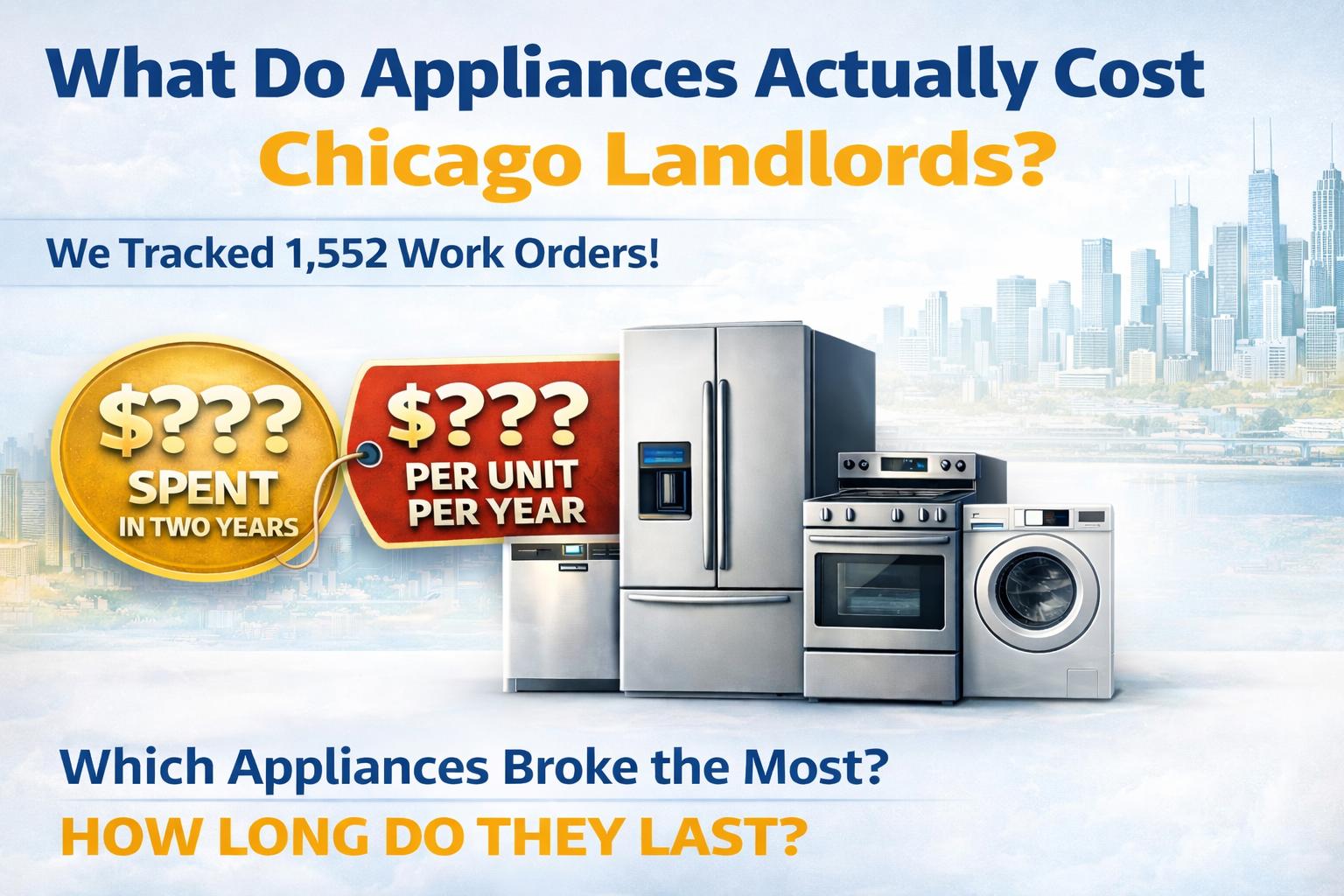
Over 2024 and 2025, our portfolio generated 1,552 appliance-related work orders totaling $571,666 in cost. That breaks down to roughly $204 per unit per year in appliance expenses, and about one appliance work order for every two units annually.
That $204 number is important. It's not a guess from a blog post or a spreadsheet template someone built in 2018. It's what 1,400+ real units across the Chicagoland area actually cost to maintain on the appliance side.
Here's how that spending breaks down: 76% of all appliance work orders were repairs, and 24% were full replacements. The average repair cost $279. The average replacement ran $646. But the median repair was only $205, meaning most repair calls are smaller fixes that a solid vendor handles quickly and gets out of there.
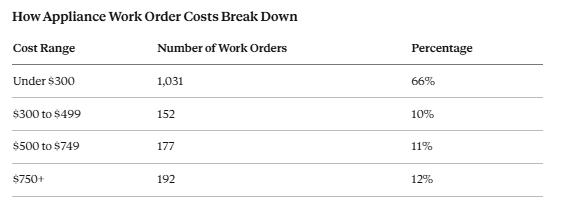
Two out of three appliance work orders (66%) came in under $300. Only 12% exceeded $750. That's the part most investors miss when they're budgeting. Appliance expenses aren't dominated by big-ticket replacements. They're driven by a steady stream of moderate repairs that add up over the course of the year.
Which Appliances Break the Most?
Not all appliances create the same headaches. Here's what 1,552 work orders told us about where the calls actually come from.
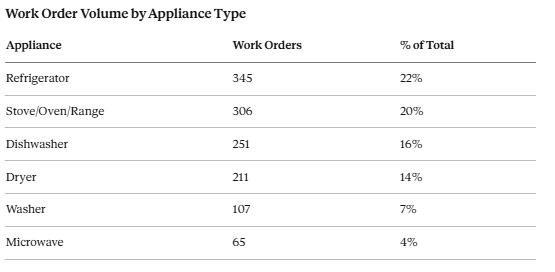
Refrigerators are the number one offender at 345 work orders, roughly 22% of all appliance calls. Stoves (or ovens, ranges, whatever you want to call them, we use all three interchangeably) are a close second at 306. Dishwashers round out the top three at 251.
Landlord Tip: When a refrigerator goes out, and your tenant calls saying they just bought $400 worth of groceries and wants you to cover it, don't panic. That's exactly what renters insurance is for. Loss of perishable food due to an appliance failure is a standard covered claim on most renters' insurance policies. Direct the tenant back to their policy and let them file the claim. This is one of many reasons we require renters' insurance on every unit we manage. It protects the tenant, and it keeps you from eating costs (literally) that were never yours to cover.
What's interesting is how the repair vs. replacement split varies by appliance.
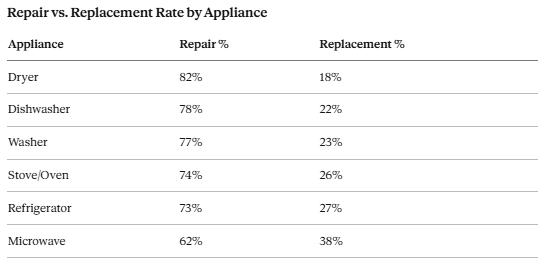
Dryers are the most repairable appliance in the data, at 82% repair rate. Dishwashers came in at 78%. Microwaves are the opposite story. 38% of microwave work orders ended in a full replacement, the highest rate of any appliance. And that makes sense if you think about it. Microwaves are tough to repair. Unless the issue is something simple like a handle that you can order the part for, there's really no point in sinking money into a microwave repair. A company like ABT Electronics in Glenview can install a brand new over-the-range microwave for around $425 all in. So when you're looking at a $250+ repair bill on a microwave that's already 7 or 8 years old, the math just doesn't work. Replace it and move on.
How Long Should These Appliances Actually Last?
Before we get into replacement costs, it's worth understanding what kind of lifespan you should realistically expect from each appliance. Most of the lifespan data you'll find online is based on owner-occupied homes, where people tend to take better care of their stuff. Rental properties are a different animal. You've got multiple tenants cycling through, heavier use, and nobody is cleaning condenser coils or descaling the dishwasher twice a year. So I've broken this out into two columns: what the industry says for owner occupied homes, and what's more realistic for investment properties.
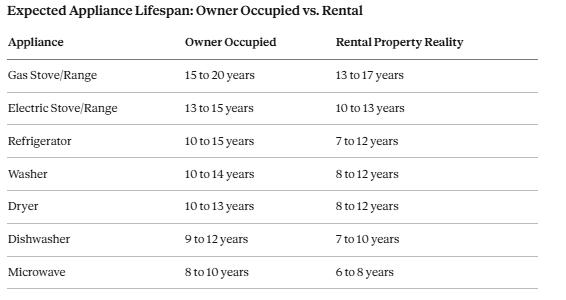
Gas stoves are the most durable appliance in a rental unit by a wide margin. The burners are simple, reliable, and don't have a ton of electronics to fail. Electric ranges have more components and tend to die sooner. Refrigerators can technically go 15 years if they're well maintained, but in a rental where tenants are stuffing the fridge, never checking the door seals, and the condenser coils haven't been touched since install, 7 to 12 years is what you should actually plan around. Dishwashers and microwaves have the shortest lifespans, which lines up with what we're seeing in our own data.
The big thing to take away here is that if you're holding a property for 10+ years, you should plan on replacing most major appliances at least once during your ownership. That's not a maybe. That's the math.
What Does It Actually Cost to Replace Each Appliance?
This is the table every investor wants but rarely gets with real numbers behind it.
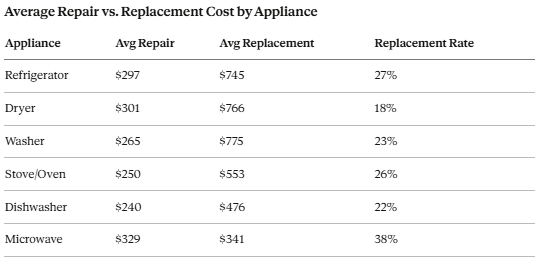
Washers and dryers are the most expensive to replace, both averaging over $760. But here's an important caveat with that number: our data doesn't break down between stackable one piece units and traditional side by side washers and dryers. That distinction matters a lot. Stackable units are generally more expensive to purchase and can be more of a hassle to service because a technician often has to unstack or work in tighter spaces. Side-by-side setups give you the advantage of replacing just one unit if it fails instead of dealing with the whole stack. If your property has the space for side by side, that's almost always the better play from a long-term cost and serviceability standpoint. Just know that the $775 average washer replacement and $766 average dryer replacement in our data are blended numbers across both configurations.
Refrigerators aren't far behind at $745. But look at dishwashers. The replacement cost is only $476 on average, which is worth noting if you're deciding whether to repair a unit that's already 10 years old or just pull the trigger on a new one.
Year Over Year: Costs Are Moving Up
We saw 730 appliance work orders in 2024 and 822 in 2025, a 13% increase in volume. But the bigger story is cost per work order. The average jumped from $334 in 2024 to $399 in 2025. That's a 19% increase in average cost year over year.
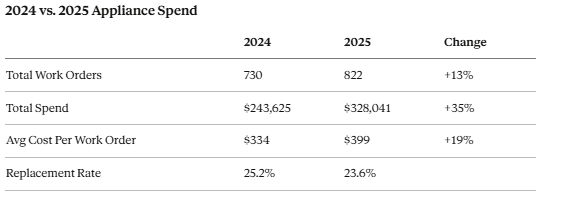
Part of that is parts pricing. Part of it is labor. But the takeaway is straightforward: if you're still using a 2022 budget for appliance expenses, you're probably underestimating by a meaningful margin. These costs move, and your underwriting needs to move with them.
Three Takeaways for Chicago Investors
1. Budget $200 to $250 Per Unit Per Year for Appliances
Most investors either don't budget for appliances at all or lump it into a vague "maintenance" line item. The data says $204 per unit per year is the baseline across a diversified portfolio. If you're buying older properties or Class C/D stock, push that number closer to $250 because those units saw the highest average costs in our data ($408 per work order for Class C properties compared to $358 for Class A/B).
2. Know the Lifespan of What's in Your Units
If you're buying a property and the seller tells you the appliances are "in good shape," that doesn't mean much. Ask how old they are. A 12-year-old refrigerator that works fine today is probably 12 to 18 months from a $745 replacement. A gas stove from 2015 probably has another decade in it. Understanding where each appliance sits in its lifecycle lets you plan ahead instead of reacting to emergencies.
Landlord Tip: Not sure how old the appliances are in your unit? Go to https://homespy.io/ and punch in the brand and serial number. It'll decode the manufacture date for you in about 30 seconds. The serial number is usually on a sticker inside the door, on the back of the unit, or under a removable panel. Way better than guessing, and it's a great tool to use during a property walkthrough before you buy.
3. A Good Repair Vendor Saves You More Than a Replacement Budget
76% of all appliance work orders are repairs, not replacements. Two thirds of those repairs come in under $300. The quality and responsiveness of your appliance repair vendor has a bigger impact on your bottom line than how much you've set aside for new appliances. A vendor who diagnoses accurately on the first visit and fixes things right saves you callbacks, tenant frustration, and the premature replacements that happen when landlords get tired of dealing with recurring issues on the same unit.
Don't Go at This Alone
Look, I get it. A lot of investors try to manage maintenance issues themselves. They're Googling model numbers at 10 PM, calling around for quotes, and trying to figure out if it's worth fixing a 9-year-old dishwasher. I've been doing this for 23 years, and I still rely on the vendor relationships and systems we've built at GC Realty to make these calls efficiently.
This is exactly the kind of thing a good property manager handles for you. We know which appliances to repair and which ones to replace. We have the vendor relationships to get competitive pricing. We track every single work order so we can show you exactly where your money is going, just like we did in this article.
If you're self-managing and this data made you realize you don't have a handle on your appliance costs, or if your current property manager can't produce numbers like these, that's worth a conversation. Reach out to us at GC Realty & Development, and let's talk about what your portfolio actually looks like under the hood.
Whether you are a first-time investor or a seasoned pro, having the right team behind you makes all the difference. If you want a data-backed rent analysis for your Chicago area investment property, reach out to us at gcrealty.com or give us a call. We’ll show you what the market says your property is worth and help you lease it fast.
Reach out today!

Partner / Co-Host of Straight Up Chicago Investor Podcast