

 Vendor Portal

Author: Mark Ainely | Partner GC Realty & Development & Co-Host Straight Up Chicago Investor Podcast
If you read our last article where we broke down 1,552 appliance work orders across our portfolio, you know that appliances cost the average Chicagoland investor about $204 per unit per year. But here's what that number doesn't tell you: your appliance costs don't hit evenly across the calendar. Not even close.
Most investors budget maintenance the same way every month. Flat number, divided by twelve, and hope for the best. But when we actually looked at when these 1,552 work orders landed, a clear pattern jumped out. There are months where your phone barely rings about appliances, and there are months where it feels like every unit in your portfolio has something going on. And what's more interesting is that the busiest months and the most expensive months aren't always the same.
Here's the seasonal breakdown from two years of real data across 1,400+ units.
The Busiest Months: Fall Takes the Crown
When we combined 2024 and 2025, the volume pattern was unmistakable. Appliance work orders ramp up starting in June, peak in October, and don't really settle down until the new year.
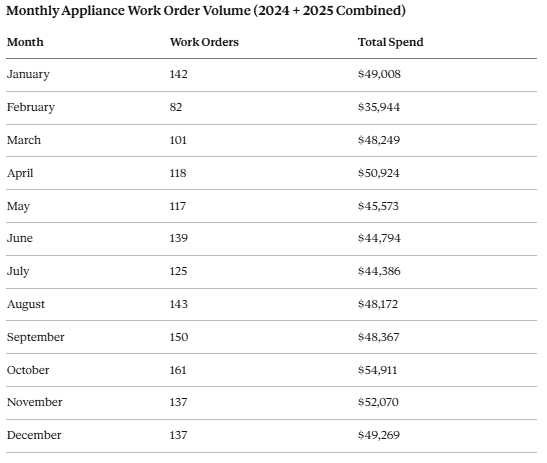
October is the single busiest month of the year at 161 work orders. February is the quietest at 82. That's nearly double the volume in October compared to February. If you're budgeting flat across the year, you're going to feel October.
When you zoom out to quarters, the pattern gets even clearer.
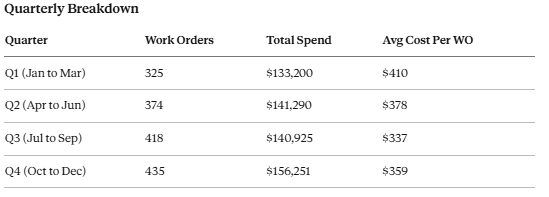
Q4 leads in total volume (435 work orders) and total spend ($156,251). But Q3 is right behind it at 418 work orders. Between July and December, we handled 853 of the 1,552 appliance work orders in the data. That's 55% of the year's appliance activity packed into the back half of the calendar.
Why Does Fall Get So Busy?
If you've managed rentals in Chicago for any length of time, you probably already have a gut feel for this. But the data confirms it. There are three things happening at once in the late summer and fall months that drive appliance volume through the roof.
Turnover season catches up. Chicago's heaviest leasing season runs from May through August. New tenants are moving in, and they're discovering every issue the previous tenant lived with or never reported. That stove burner that only half works? The old tenant dealt with it for two years. The new tenant calls on day one. We see this play out clearly in the stove/oven numbers. Fall had 100 stove related work orders compared to just 61 in winter. New tenants move in, turn on the oven for the first time, and pick up the phone.
Summer heat punishes refrigerators. Refrigerators are already the number one appliance for work orders in our portfolio, but they spike hard in summer. We logged 104 refrigerator work orders in summer compared to 79 in winter. When the ambient temperature in a kitchen goes up, the compressor works harder, the condenser coils get hotter, and units that were barely hanging on start to fail. This is especially true in older buildings without central air where kitchen temperatures can climb well above 80 degrees.
The compounding effect. By the time you hit September and October, you're dealing with the tail end of summer fridge failures, new tenant discoveries from August and September move ins, and the beginning of the holiday stretch where tenants start cooking more and using ovens they may not have touched since they moved in. It all stacks on top of each other.
Which Appliances Spike When?
The seasonal patterns aren't the same for every appliance. Here's how the six major appliance categories broke down by season.
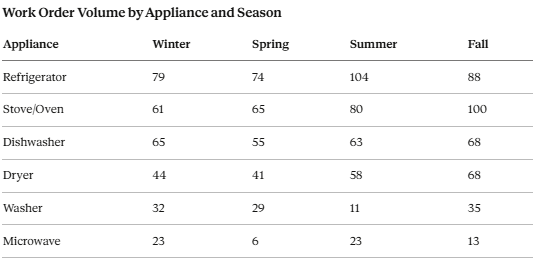
Refrigerators peak in summer (104 WOs) for the reasons we already talked about. Heat kills compressors.
Stoves peak in fall (100 WOs), which aligns with new tenant move ins and the transition into cooking season as the weather cools down.
Dryers are interesting. They peak in fall (68 WOs) and hit their lowest point in spring (41). As the weather gets colder and tenants shift from air drying clothes or wearing lighter fabrics to running heavy loads of blankets, sweaters, and winter gear, dryers take a beating. Fall is also when lint buildup from summer use starts to cause real problems.
Dishwashers are the most consistent appliance across seasons, ranging from 55 to 68 work orders per quarter. People use their dishwasher the same amount regardless of the time of year, so there's no real seasonal driver there.
Three Takeaways for Chicago Investors
1. Build a Cash Reserve Before Q3 and Q4
55% of all appliance work orders in our data landed between July and December. If you're going to have a rough stretch on the appliance side, this is when it's going to happen. Smart investors make sure they have cash reserves built up heading into summer rather than scrambling in October when three units need attention in the same week.
2. Schedule Preventive Walkthroughs in Spring
The best time to catch an appliance that's on its last legs is before it fails during peak season. If you or your property manager can do a quick walkthrough in April or May, you can identify the fridge that's running too warm, the dryer vent that needs cleaning, or the stove burner that's not igniting consistently. Dealing with those proactively in the quiet months is cheaper, easier to schedule, and way less stressful than handling them as emergencies in August.
3. Expect New Tenants to Find Problems
This is one of those things that experienced landlords know but newer investors get caught off guard by. When a new tenant moves into a unit, they are going to find things. The old tenant lived with that wobbly dryer and that slow draining dishwasher for two years. The new tenant is not going to do the same. Budget for a bump in appliance calls 30 to 60 days after any new lease start, especially during the summer and fall leasing season. It's not that the property was poorly maintained. It's that fresh eyes notice everything.
Don’t Go At This Alone
This is a lot of information you need to know if you plan to invest in the Chicago market and it may seem overwhelming, but real estate investing in Chicago is a team sport. Who is on your real estate investing team? Do you even have a team? GC Realty & Development has a team of resources and we are willing to share all of our 20+ years of experience in both real estate investing and property management in the Chicago market. We will do this whether you hire us or not.
What gets me up in the morning and keeps me going 12+ hours a day is the ability to add value to Chicago real estate investors. If we connect, you will hear me say that our goal as a company is to add value to everyone we come in contact with. In return, we hope one day you will hire us for our Tenant Placement or Property Management Services. You can also refer us to someone you know that needs Tenant Placement or Property Management services, or I will take a simple 5 Star Google review. We love the opportunity when we get all three from the current and aspiring investors we get to help!
Reach out today!
Partner / Co-Host of Straight Up Chicago Investor Podcast
Mark Ainley is the owner and managing partner of GC Realty & Development, LLC, Chicago's Responsive Property Manager®, managing 1,400+ units across the Chicagoland area. He is also the co-host of the Straight Up Chicago Investor podcast.