

 Vendor Portal

Author: Mark Ainely | Partner GC Realty & Development & Co-Host Straight Up Chicago Investor Podcast
The most common question we get from investors is some version of the same thing. What should I buy? Single family homes, a condo or townhouse, or a small multi family building? Everyone has an opinion, and most of those opinions are built on a gut feel or one deal that went well or badly a few years back.
There are a lot of factors that go into that decision. Financing, price per door, cash flow, how much work the property needs, and how hands on you want to be all matter. But one factor that does not get talked about enough is demand. How fast will it lease, and how many renters actually raise their hand when it hits the market. Vacancy is one of the biggest costs an owner carries, so the answer to that question hits your return directly. That is the specific point we are going to break down today.
We leased 215 units across Chicago and the suburbs in the first half of 2026, and they split across all three property types. So instead of guessing which one renters actually want, we pulled the application counts, the days on market, and the pricing for every one of them and let the numbers do the talking.
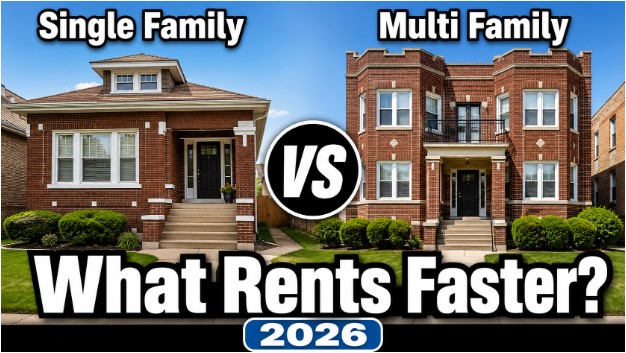
The short version is that single family homes were the clear demand king in the first half of 2026. They pulled the most applications, leased the fastest, held their price the best, and needed a price cut the least often. But the full story has some important nuance for anyone deciding where to put their next dollar, so stick with me.
The Scorecard
Here is how the three property types stacked up across the units we leased this year. Every number below is pulled straight from our leasing data.
Property Type | Avg Applications | Median Days on Market | Needed a Price Cut | Hit or Beat Target Rent | Median Rent |
|---|---|---|---|---|---|
Single Family | 7.6 | 20 | 41% | 98% | $2,712 |
Condo / Townhouse | 5.5 | 23 | 45% | 94% | $2,300 |
Multi Family | 4.9 | 31 | 49% | 93% | $1,612 |
Single family homes win every column. They drew about 55% more applications per listing than multi family units, leased eleven days faster at the median, and were the least likely to need an asking rent reduction before a lease was signed. Nearly all of them, 98%, leased at or above the rent we targeted on day one.
Multi family units sat at the other end. They pulled the fewest applications, took the longest to lease at a median of 31 days, and were the most likely to need a price cut. That does not make multi family a bad investment, and we will get to why in a minute, but on pure renter demand per unit, it finished last.
We Saw This Earlier in 2026, and the Gap Is Growing
This is not a brand new pattern. Earlier in 2026 we reported that across the Chicago metro, single family homes were leasing in about 17 days and multi family units in about 20, something we covered in our market guides like the Franklin Park rental market guide. Even then, single family was the faster mover, just by a hair.
In our own leased portfolio for the first half of 2026, that edge is even wider. Single family sits at a median of 20 days and multi family at 31. I want to be straight about the comparison, because the metro number was a broad average and the figures in the scorecard are the median on our own book, so this is not a clean apples to apples read. But the direction is the same in both, and in our own book single family's advantage is a lot larger.
Why Single Family Pulls More Renters
Here is the part that actually explains the scorecard, and it is not really about the building type at all. It is about what comes inside the building type.
When we sorted every listing by the amenities it offered, the gap was staggering.
Property Type | Has In Unit Laundry | Has a Garage or Dedicated Parking |
|---|---|---|
Single Family | 94% | 81% |
Condo / Townhouse | 81% | 63% |
Multi Family | 22% | 20% |
We have written before that in unit laundry is the single strongest driver of application volume in our whole dataset. Look at where in unit laundry lives. Almost every single family home has it. Barely one in five multi family units does. Same story with a garage or a dedicated parking spot.
So single family homes are not winning because renters have some deep preference for a detached house. They are winning because a single family home almost always comes packaged with the two features renters ask us for most. The property type is really a proxy for the amenity bundle. A multi family unit with in unit laundry and a parking spot competes very differently than the shared basement coin laundry unit down the block, and that is a lever an owner can actually pull.
There is a household piece too. Single family homes in our data skewed toward three and four bedrooms, which pulls families. Families move less often, tend to stay longer, and treat the home like it is theirs. Multi family units skewed toward one and two bedrooms and a younger, more mobile renter. Neither is wrong, but they are different games with different turnover.
The Rent Story
Single family homes also carry the highest rents by a wide margin, a median of $2,712 versus $1,612 for multi family. That is the tradeoff sitting underneath the whole conversation. A single family home is one door at a high rent. A small multi family building is several doors at lower rents each.
That difference is exactly why the demand scorecard does not settle the question of what to buy on its own.
Whether you already own a property or you are sizing up a purchase, the first thing to nail down is what it will actually rent for in today's market. Our team will run you a free rent analysis on any address, no strings attached, so you are working from a real number instead of a guess.
If you would rather have our team handle the leasing on whatever you own, our tenant placement service markets, screens, and places a qualified resident for a one time fee equal to one month of rent, then hands the keys back to you.
The Fair Case for Multi Family
Multi family finished last on demand per unit, but demand per unit is only one input, and for a lot of investors it is not even the most important one. Here is what the leasing data does not show.
A multi family building spreads your vacancy risk across several doors. When one unit in a four flat turns, you lose a quarter of that building's income for a few weeks, not all of it. A single family home is all or nothing. When it is vacant, your income on that property is zero until it leases.
Multi family also tends to win on price per door and on cash flow. Lower rents draw from the largest and deepest pool of renters in the market, which is part of why the affordable end never really slows down. And the biggest reason multi family looked slower and needed more price cuts in our data is the amenity gap above, not something baked into the building. Add in unit laundry to a multi family unit and you have closed a big chunk of the distance to a single family home, at a cost that pays itself back in faster leasing and less vacancy every single turn.
Condos and townhouses land in the middle on almost everything, which fits. They usually offer in unit laundry and often a garage, but they come with association rules and shared walls that a detached home does not.
If you want to see what it costs to hand off the leasing and management on any of these, our property management pricing lays out exactly what is included.
What This Means If You Are Deciding What to Buy
The data points to a fairly clean way to think about it.
If your goal is the least vacancy drama, the strongest pricing power, and a longer term resident on a single door, single family is hard to beat right now. It leases fastest, holds rent best, and rarely forces a price cut. Just know you are exposed on that one door when it turns.
If your goal is scale, diversified vacancy risk, and cash flow per dollar invested, multi family still makes a lot of sense, and you can erase most of the demand penalty by making sure your units have in unit laundry and a parking option. Do not buy a multi family unit and leave it without laundry if you can help it. The data says that is money left on the table.
Whatever you buy, the amenities inside it move the needle more than the label on the outside. That is the real takeaway from the first half of 2026. And before you commit either way, get a free rent analysis so you know what the property will command in today's market and can run the numbers on real rent, not a hopeful one.
Frequently Asked Questions
Which property type leases fastest in Chicagoland? In the first half of 2026, single family homes leased fastest at a median of 20 days, followed by condos and townhouses at 23 days, then multi family units at 31 days.
Do single family homes really get more applications? Yes. Single family homes averaged 7.6 applications per listing versus 4.9 for multi family, about 55% more demand per unit. Most of that traces back to amenities, since single family homes almost always include in unit laundry and parking.
Is multi family a worse investment then? No. Multi family finished last on renter demand per unit, but it spreads vacancy risk across multiple doors, draws from the largest renter pool, and often wins on cash flow per dollar. Much of its demand gap comes from missing amenities like in unit laundry, which an owner can add.
What is the single best thing I can do to boost demand on any unit? Add in unit laundry. It is the strongest driver of application volume in our data across every property type, and it is the main reason single family and condo units out drew multi family this year.
I hope you pull some takeaways from this one. If you want our team to handle your tenant placement or property management, click here.
Don't Go At This Alone
This is a lot to track if you plan to invest in the Chicago market, and it can feel like a lot. But real estate investing in Chicago is a team sport. Who is on your team? Do you have one?
GC Realty & Development has a deep bench of resources, and we are happy to share more than 20 years of experience in both real estate investing and property management in this market. We will do that whether you hire us or not.
What gets me up in the morning and keeps me going 12 plus hours a day is the chance to add value to Chicago real estate investors. If we connect, you will hear me say that our goal as a company is to bring value to everyone we come in contact with. In return, we hope that one day you hire us for tenant placement or property management, that you refer us to someone who needs those services, or that you leave us a simple 5 star Google review. We love it when we get all three from the investors we get to help.
Related reading: Chicagoland First Half 2026 Leasing Results and Inventory Is Low. What Does That Mean for Chicago Investors?
%20(3)%20(1)_3.png)
_1.png)