

 Vendor Portal

Author: Mark Ainely | Partner GC Realty & Development & Co-Host Straight Up Chicago Investor Podcast
If you own rental property in DuPage County, Section 8 applicants are part of your tenant pool whether you planned for it or not. Illinois protects source of income, which means you can't turn someone away just because they have a housing voucher. The good news? Figuring out what the housing authority will actually pay you is far more straightforward than dealing with the Chicago Housing Authority. The bad news? Most landlords still get tripped up by details that kill deals after weeks of waiting. As an investor myself and property manager of 1,400+ properties, with over 500 located in DuPage County, I have a few tips you should know.
Start With the Payment Standards Chart
DuPage County makes this part easy. Go to the DuPage Housing Authority website and look up their payment standards chart. You'll find the maximum amount they'll pay based on bedroom count and zip code.
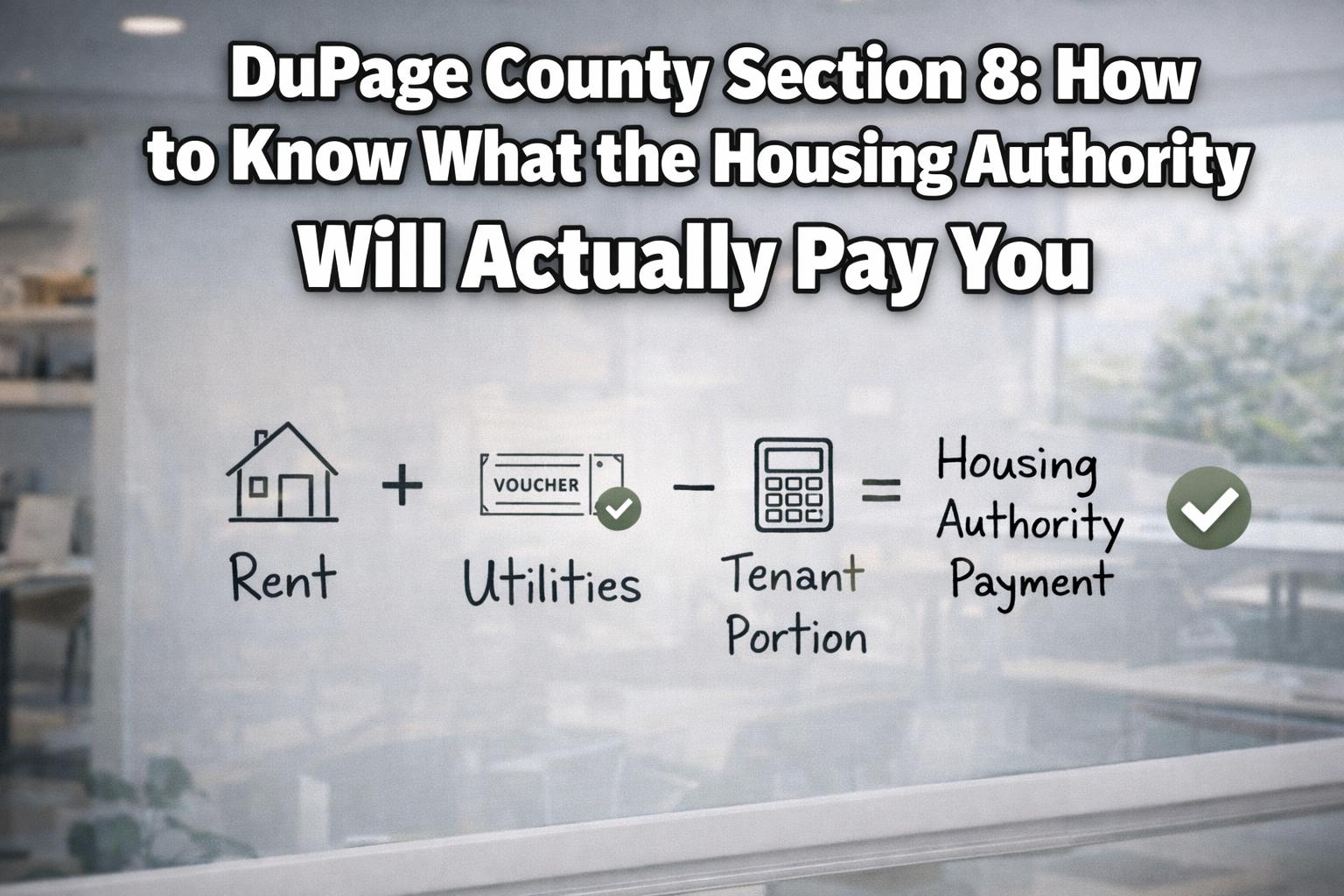
But here's where landlords get caught: that maximum assumes you're paying all utilities. If the chart shows $2,400 for a two-bedroom in your zip code, that's with you covering gas, electric, water, everything.
The reality? Most landlords put utilities back on the tenant. Every time you do that, subtract roughly $100 from that maximum for each utility. Tenant pays gas, electric, and water? Take $300 off that $2,400. Your realistic max is now $2,100.
Do this math before you even talk to an applicant. It takes two minutes and saves you from chasing rent amounts that were never possible.
Protected Class Doesn't Mean You Have to Accept Below-Market Rent
Here's something important to understand: even though source of income is a protected class in Illinois and you're obligated to treat Section 8 applicants the same as market tenants, you're not required to accept a tenant if the numbers don't work. You can't reject someone simply because they have a voucher, but you can reject them if their voucher doesn't meet your rent requirements, just like you'd pass on any market tenant who couldn't afford the rent.
For example, if your three-bedroom is listed at $3,200 and the Section 8 payment standard caps out at $2,800 before any utility reallocation, you can respectfully pass. The protection is against discrimination based on source of income, not a requirement to accept below-market rent.
The Voucher Size Mismatch
This happens constantly. A tenant with a two-bedroom voucher applies for your three-bedroom property. They love the place. You love the idea of filling your vacancy. Everyone's excited.
Here's the problem: that tenant can absolutely rent your three-bedroom unit, but you'll only get paid at the two-bedroom rate. The housing authority pays based on voucher size, not your actual bedroom count. Your three-bedroom property just became a two-bedroom income stream.
I see this all the time, two-bedroom vouchers looking at three-bedrooms, three-bedroom vouchers looking at fours. It's incredibly common because larger vouchers are harder to come by. The rules changed back in 2012, tightening household composition requirements. Five and six-bedroom vouchers are extremely rare now. You could have a tenant with eight kids and a parent who only qualifies for a five-bedroom voucher.
So if you're buying that large single-family home in Carol Stream thinking you'll capture premium Section 8 income, understand your applicant pool is very limited. Ask for voucher size upfront during your screening process. It's not rude, it's necessary.
Bedroom Qualification Standards: Where Deals Die
What qualifies as a bedroom for Section 8 purposes has specific technical requirements, and this is where I see suburban landlords make costly errors. These standards come from HUD guidelines, so they apply whether you're in Wheaton, Lombard, or anywhere else in DuPage County.
Minimum Square Footage
Every bedroom must be at least 70 square feet. Not 69 and a half, 70 square feet exactly. That small den or converted office you've been calling a bedroom? Measure it carefully.
One thing that surprises people: you don't actually need a closet for a room to qualify as a bedroom. A room without a closet can still count. That said, I always tell investors to think about what tenants actually want. People expect closets, even if the housing authority doesn't require them.
The Ceiling Height Trap
Here's where attic conversions and basement bedrooms get landlords in trouble. The only floor space that counts toward your 70 square feet is area where the ceiling is seven feet or higher.
Think about what this means for an attic bedroom with a sloped ceiling. Those corners where the roof angles down? None of that square footage counts. I've seen attic bedrooms that looked generous but only had about 60 qualifying square feet once you measured properly. That room doesn't count as a bedroom anymore.
Basements create the same issue. Picture a 10-by-7 room, that's exactly 70 square feet. But if there's a soffit running through bringing the ceiling down to 6 feet in that section, that entire area gets excluded. Your 70-square-foot room just became 50 square feet, and it no longer qualifies.
I've watched investors buy properties advertised as four bedrooms, only to have the housing authority classify them as three-bedrooms after inspection. Their entire investment analysis was wrong from day one.
Ventilation Requirements
Common misconception: you need a window that opens. Not true. You just need something that ventilates. A glass block window with a small cutout that opens counts for Section 8. Solid glass block with no ventilation option? That room won't qualify.
What You Cannot Do: Side Payments
I'll say this directly because I see it in the suburbs just like I see it in the city. Landlords tell me their tenant pays $1,800 from the housing authority plus $300 on the side. Do not do this.
You cannot accept anything above your HAP contract amount, that's the Housing Assistance Payment agreement between you and the housing authority. The penalties are severe: you get banned from the program, and there are other HUD consequences that follow you. Plus, side payments aren't even enforceable. When the tenant stops paying that extra $300, who are you going to report them to? You can't chase it.
What you can do legitimately: charge separately for parking or storage at actual market rates. But be realistic about what market rate actually means in your area.
Get Your Numbers Right Before You Start
Section 8 in DuPage County can be reliable, predictable income, but only if you do the math upfront. Check the payment standards, subtract for utilities, verify voucher size, and make sure your bedrooms actually qualify before you accept an application.
If you have questions about Section 8 in DuPage County or anywhere else in the Chicago suburbs, my team at GC Realty and Development deals with this daily. Schedule a call and we'll help you figure out what you can realistically expect, before you learn the hard way.
Want to skip the headaches entirely? Learn more about our tenant placement or property management services across Chicagoland.