

 Vendor Portal

Author: Mark Ainely | Partner GC Realty & Development & Co-Host Straight Up Chicago Investor Podcast
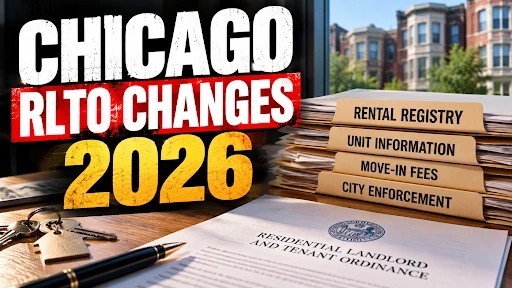
Chicago is about to rewrite the rules for every landlord in the city, and most owners I talk to have no idea how close it is. Two competing proposals to overhaul the Residential Landlord and Tenant Ordinance, the RLTO, have already cleared City Council committees. A full vote was on the table this week before it got pushed to later this fall. If you own rental property in Chicago, you are at risk of new fees, new paperwork, new limits on what you can collect at move in, and a new layer of city enforcement. This article walks through where that risk sits so you are not caught flat footed.
First, the context. Mayor Brandon Johnson's Protecting Renters Ordinance, or PRO, passed the Committee on Housing and Real Estate 12 to 9. The rival proposal from Ald. Gilbert Villegas, known as FAIR, passed the Zoning Committee 12 to 6. On September 23 the full City Council deferred both, which means neither one is law yet and the fight moves to a meeting later this fall. That is a delay, not a win. One of these, or some blend of the two, is very likely coming.
At GC Realty we manage roughly 1,500 units for over 500 private investors across the Chicago area, so we follow these ordinances closely because our owners feel every one of them.
Key Takeaways
Neither proposal is law yet. Both were deferred by City Council on September 23, 2026 and are expected back later this fall.
Both versions would require every Chicago rental owner to identify themselves to the city through some form of registration.
The mayor's version adds a $20 to $60 per unit annual fee, bans move in fees, caps application fees, and creates a new city bureau to enforce the rules.
Small owner occupied buildings that are exempt from much of the RLTO today could get pulled in under the mayor's version.
Do not rewrite your lease today. Do get your records, fees, and maintenance documentation in order so you can adjust fast.
1. A Citywide Rental Registry Puts Every Unit On The City's Radar
Both proposals require rental owners to register with the city. That part is almost certainly coming no matter which version wins.
Under the mayor's version, most landlords would pay between $20 and $60 per unit every year, with the bigger buildings paying the higher rate. On a 12 unit building at $40 a unit, that is $480 a year. On a 50 unit building at $60 a unit, that is $3,000 a year. Nobody is losing a building over $480, but the fee is not really the point. Somebody has to register every unit correctly, track the renewals, keep the ownership and management contacts current, and make sure nothing gets missed. The early drafts talked about disclosing things like unit counts, bedrooms, occupancy, rent, and ownership interests. That is a compliance system, not a form.
Here is what I would watch. Once the city has a database of every rental unit and every owner, it becomes a lot easier to build more requirements on top of it. I am not saying inspections or rent reporting are guaranteed. I am saying the infrastructure makes them easy to add later, and that is a risk every owner should understand going in.
2. Your Move In Money Could Look Very Different
This is the one that will hit your wallet first, so stay with me.
The mayor's proposal would ban move in and move out fees outright and points toward capping security deposits at one month of rent. FAIR goes the other way. It would keep move in fees and cap deposits at a month and a half of rent.
Put real numbers on it. On a $2,200 apartment, one month is $2,200 and a month and a half is $3,300. That is $1,100 less protection under the mayor's version. Now picture a resident who leaves owing the last month's rent and $2,500 in damage. That $1,100 is not theoretical anymore.
A lot of Chicago landlords, myself included, moved to move in fees in the first place because the security deposit rules under the RLTO are brutal. One paperwork mistake on a deposit can cost you far more than the deposit itself. Take the move in fee away and owners are pushed back into that risk. The risk does not disappear. It moves to tighter screening, bigger turn budgets, and higher rents.
3. A $20 Application Fee Cap Squeezes Your Screening
The mayor's draft caps application fees at $20 or the actual cost, whichever is lower. It also limits pet charges to either a one time fee or a recurring fee, not both.
Twenty dollars sounds fine until you add up credit, eviction history, identity and income verification, and the time it takes to process a file. After placing thousands of tenants, I can tell you the expensive decision is never the $20 or $50 you spend on screening. It is who gets the keys. One bad placement can mean three months of no rent, attorney fees, court costs, damage, and another vacancy. That is thousands of dollars, not twenty. Whatever happens with this cap, do not loosen your screening standards to make up for it.
4. Small Owner Occupied Buildings May Lose Their Exemption
If you live in your own two flat or three flat, you have probably been told the RLTO does not apply to you. Today that is largely true for owner occupied buildings of six units or fewer.
The mayor's version would change that and bring those buildings under the ordinance, while waiving the per unit fee if the owner lives in the building. So you may not pay the registry fee, but you could still have to register and follow rules you have never had to follow before. FAIR takes the opposite approach and would actually expand exemptions to owners with up to 12 units across the city, even if they do not live in one.
That is exactly why I hate the line “my building is exempt.” Exempt from what, and under which version? If you own a small building, this is the section to read closely when the final text comes out.
5. A New Layer Of City Enforcement And Fines
Everybody notices the new fees. Fewer people notice who enforces the rules, and that might be the bigger change.
Today most RLTO enforcement happens through tenants suing landlords. The mayor's version creates a Bureau of Rental Housing Services inside the Department of Housing, funded by those registry fees, with the authority to investigate complaints and go after landlords who break the rules. FAIR would hand enforcement to the Department of Buildings instead. Either way, the city itself becomes a second party that can come after you.
That changes how you have to operate. “I know I fixed it” is not good enough. You need to prove it. A no heat call at 8:12 in the morning should show the work order, the resident contact, the vendor dispatch, the arrival, the repair, the invoice, and the photos. We have processed tens of thousands of work orders across our portfolio, and I can tell you that record is almost as important as the repair. If it is not documented, you will have a hard time proving it happened.
Where This Stands And What You Can Do
None of this is settled. Both proposals are waiting on a full City Council vote later this fall, and the final version could look different from either one. I would not rewrite your lease, drop a lawful fee, or change your deposit today because of a proposal. I would get your operation ready so you can move fast when the rules are final.
Start with four things. Make sure you can pull accurate information on every unit you own, including the address, unit number, bedrooms, current rent, ownership entity, and management contact, without spending three days digging for it. Know every fee you charge, from the application fee to the move in fee to pet and utility charges, so you know exactly what to change if the rules change. Make sure you can prove how you handled a maintenance complaint six months ago, not just remember it. And make sure your rental is actually priced right, because compliance protects the investment but it does not make it perform. An apartment that should rent for $2,200 sitting empty for a month at $2,400 costs you $2,200, and it takes 11 months of that extra $200 just to break even.
The RLTO is 40 years old and there is broad agreement that parts of it need updating. The question is how much new cost and risk lands on housing providers in the process. Right now is the window to read the proposals, understand how they would hit your buildings, and let your alderman know where you stand.
Frequently Asked Questions
Did Chicago pass new RLTO rules? No. Both the Protecting Renters Ordinance and the rival FAIR proposal cleared committee, but the full City Council deferred them on September 23, 2026. A vote is expected later this fall.
Will Chicago landlords have to register their rental properties? Very likely. Both proposals require rental owners to identify themselves to the city. The fees, the details required, and who enforces it differ between the two versions.
How much would the rental registry cost? Under the mayor's proposal, most landlords would pay between $20 and $60 per unit per year, with larger buildings paying more. The fee would be waived for certain small owner occupied buildings.
Is Chicago banning move in fees? Not yet. The mayor's version would ban move in and move out fees. The FAIR version would keep them and cap security deposits at a month and a half of rent.
Would application fees be capped? The mayor's draft caps application fees at $20 or actual cost, whichever is lower. Illinois also has its own rules on screening fees, so check both.
Does this affect my owner occupied two flat or three flat? It could. The mayor's version would bring owner occupied buildings of six units or fewer under the ordinance with the registry fee waived. FAIR would expand exemptions instead. Read the final text closely.
Does this apply to suburban landlords? No. The Chicago RLTO applies inside the city. Suburban owners may be covered by the Cook County RTLO, Illinois law, or their own town's rental rules.
Should I change my lease now? No. Wait for final language and an effective date. What you can do now is organize your records and know which processes would need to change.
Related Resources
5 Ways Brandon Johnson's Proposed RLTO Changes Will Hurt Chicago Tenants
Chicago Landlord Secrets: Proposed CRLTO Details, Investing On South Side, & 2026 Chicago Leasing
Don't Go At This Alone!
Chicago's rental rules were already complicated, and they are about to get more complicated. At GC Realty & Development we manage roughly 1,500 units across the Chicago area, and staying ahead of ordinances like this is part of what we do every day. Whether you own one unit or a hundred, we can help you understand what is coming, keep you compliant, and protect your investment.
My mission has always been to help Chicago owners buy their time back and lower their risk so they can build real wealth through real estate without the ordinance headaches taking over their lives. If you want a partner who reads the fine print so you do not have to, let's talk.
%20(3)%20(1)_3.png)
_1.png)