

 Vendor Portal

Author: Mark Ainely | Partner GC Realty & Development & Co-Host Straight Up Chicago Investor Podcast
When investors ask us about crime in a Chicagoland market, they usually ask the wrong question first. They ask, "What's the crime rate?" The better question is, "What's the crime trend?" A town with a slightly elevated current crime rate that has been trending down for five years can be a stronger investment story than a town with a low current rate that's been creeping up. Trend tells you where the market is heading. Snapshot only tells you where it is.
This is the second article in our DuPage County data series. We covered the legal context behind these articles in detail here: What Real Estate Brokers Can Now Say About Crime and Schools: HUD Just Changed the Rules. The April 2026 HUD guidance cleared real estate professionals to share neighborhood crime data and trend information with clients, provided the data is presented factually and consistently across all clients.
At GC Realty & Development, we manage roughly 1,500 units across Chicagoland, including a meaningful book of business in DuPage County. That portfolio gives our team a real-time read on where tenants are renewing, where insurance costs are creeping, and where the data on paper actually matches what's happening on the ground. Today we're focused on one specific question: which DuPage County municipalities have shown the most meaningful crime declines over the past 5 years?
Before we dig in, a positioning note: we like DuPage County for investors. A lot. The county-level fundamentals are strong, our team has both professional and personal roots in the area, and the data we walk through below operates within an already-favorable backdrop. The within-county trend variation is where the actual investor decisions get made.
New to this series? Article 1 covers the snapshot ranking: The 5 Safest DuPage County Suburbs for Real Estate Investors (FBI Data). That article identifies the lowest crime towns in the county at this moment in time. This article identifies which towns have been getting safer fastest. Read both together if you're underwriting a new market. The current rate plus the trend line is a stronger underwriting signal than either one alone.
DuPage County by the Numbers: How the County Stacks Up
Quick context before we drill into the trend story for individual towns. DuPage County overall is one of the safer counties in Illinois and one of the safer counties in the country, full stop:
Violent crime rate: roughly 1.91 per 1,000 residents in the typical year, well below the Illinois state average of 2.78 per 1,000 and the national average of 3.69 per 1,000.
National safety percentile (overall crime): 76th, meaning DuPage is safer than 76% of all U.S. counties.
National safety percentile (violent crime specifically): 93rd, meaning DuPage is safer than 93% of U.S. counties on violent crime.
Source: CrimeGrade.org typical-year analysis based on FBI UCR data, cross-referenced with FBI Uniform Crime Reporting 2024 (released October 2025) for the Illinois and national rates.
These are real numbers, not marketing copy. DuPage County is one of our favorite Chicagoland submarkets for buy-and-hold investors specifically because the county-level fundamentals are strong: the safety profile beats both state and national averages, the schools are well-funded, the property values are stable, and access to Chicago and the western employment corridors is easy. The trend story below operates within that already-favorable backdrop. We're not picking towns out of a struggling county. We're identifying the towns within a strong county that are getting even better.
Key Takeaways
DuPage County overall ranks in the 93rd percentile nationally for violent crime safety, with a county-level violent crime rate roughly half the national average and well below the Illinois state average. The trend story below operates within that already-strong county-level backdrop.
HUD's April 2026 ruling cleared real estate professionals to share crime trend data with investors, provided the data is presented factually and consistently across all clients.
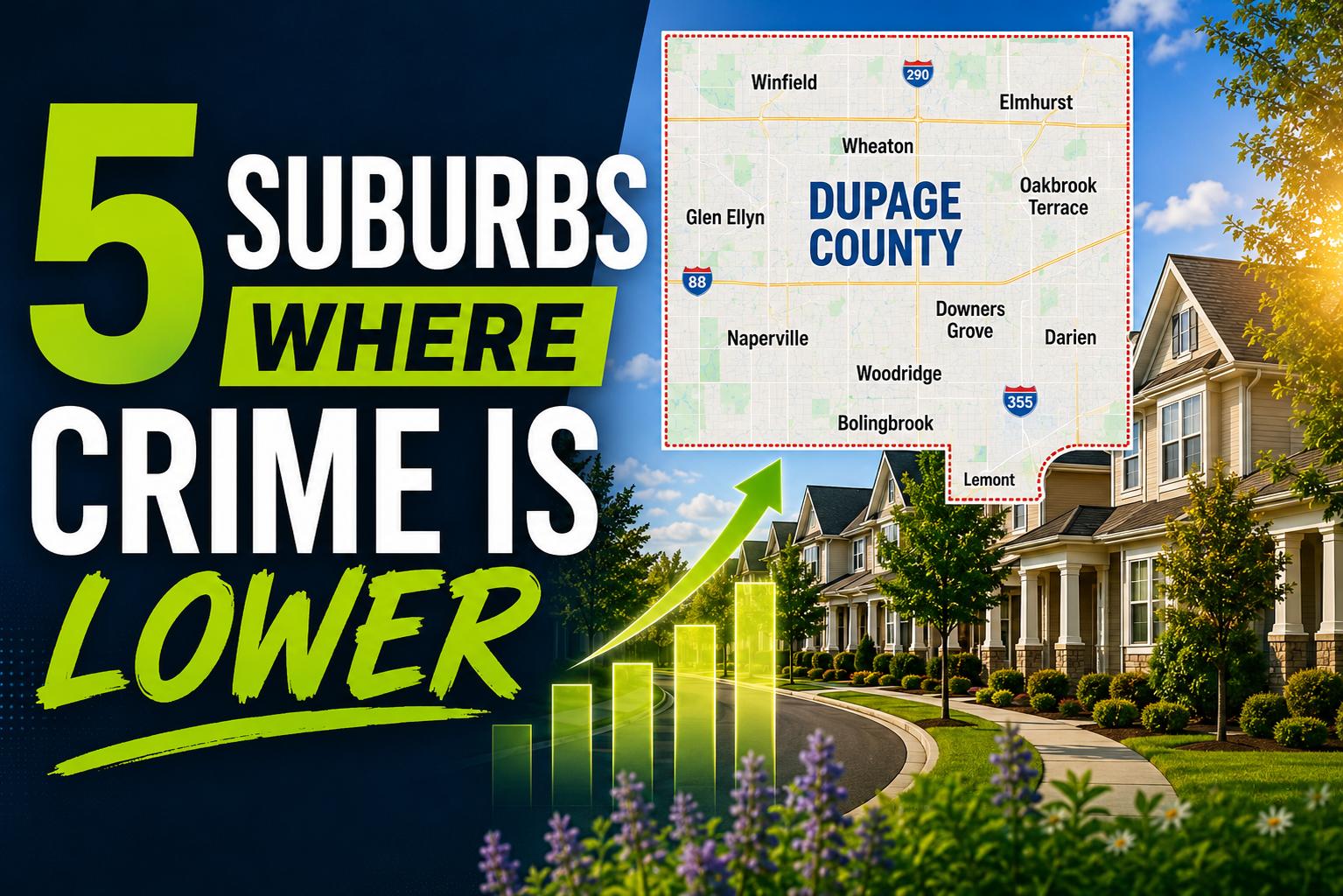
The 5 DuPage County towns where crime has been trending down most meaningfully over the past 5 years: Addison, Wheaton, Elmhurst, Lisle, and Westmont.
All 5 towns show declining violent crime over the multi-year window per City-Data analysis of FBI UCR submissions, with several also showing declining property crime over the same window.
Addison stands out for the cleanest year-over-year improvement story, with violent crime per 100K residents falling from 133.6 in 2019 to 97.1 in 2024, a roughly 27% decrease.
Lisle and Westmont posted the largest single-year crime rate declines among the group in 2024, with City-Data crime index drops of 27% and 22% respectively versus 2023.
Several DuPage towns moved the opposite direction over the same window, including Bensenville, Villa Park, Glendale Heights, Naperville, Roselle, and Itasca, all showing rising violent crime over the multi-year window.
For investors, towns with declining crime trends often offer better appreciation potential than towns at the absolute crime rate floor, where there's less room for further improvement.
How We Built This Ranking
Data sources: Multi-year crime data was sourced from City-Data.com, which compiles year-by-year FBI Uniform Crime Reporting (UCR) submissions at the municipal level for towns going back to 2007. We cross-referenced trend direction against CrimeGrade.org typical-year averages and NeighborhoodScout's analysis of FBI 2023 calendar year data. The single-source data shouldn't be treated as the final word on any specific town, but the directional signal across multiple years of FBI submissions is meaningful and consistent.
Geographic scope: Every DuPage County municipality with its own reporting law enforcement agency was screened. Towns spanning multiple counties (such as Hanover Park, which is primarily Cook County) were excluded from this DuPage-focused list to keep the analysis clean.
Trend metric used: City-Data's summary classification of "rise" versus "decline" of violent crime over the 5-year window, supplemented with year-over-year change percentages where available. For Addison specifically, we calculated the percentage change in violent crime rate per 100,000 residents from 2019 to 2024 directly from the year-by-year tables. Where year-by-year specific data was not available, we relied on the multi-year directional summary.
Why violent crime trend specifically? Violent crime (FBI Part I: murder, rape, robbery, aggravated assault) is the metric most correlated with tenant decisions, insurance underwriting, and long-term neighborhood reputation. Property crime tends to follow different patterns and is also worth tracking, but violent crime trend is the cleaner investor signal.
Investor metrics included: Median single-family residence (SFR) sale price using trailing 12-month data from Redfin, Homes.com, and Zillow. Population data from City-Data 2024 estimates and U.S. Census Bureau.
Why 5 years instead of a longer or shorter window? A 5-year window is long enough to smooth out single-year reporting anomalies (which can be significant in smaller municipalities) but short enough to reflect current trajectory rather than ancient history. It also captures the post-pandemic period, which is a more relevant investor window than the pre-2020 baseline for most current underwriting decisions.
DuPage Isn't a Monolith: Within-County Trend Variation
The county-level numbers we covered earlier are strong, but the within-county trend picture is more mixed than the county-level snapshot suggests. Per City-Data's multi-year analysis of FBI UCR submissions:
Some DuPage towns have seen meaningful declines in violent crime over 5 years, including the 5 we feature below.
Other DuPage towns have moved the opposite direction over the same window. Bensenville, Villa Park, Glendale Heights, Naperville, Roselle, and Itasca all show rising violent crime over the multi-year window per City-Data analysis.
A few DuPage towns show split trends, such as Bloomingdale (violent declining, property up) and Carol Stream (violent up, property down).
The key takeaway for investors: within a county that ranks in the 93rd percentile for violent crime safety nationally, you have towns trending sharply down and towns trending up. Underwriting at the county level masks this. Underwriting at the town level surfaces it. That's the entire point of this article.
The 5 DuPage County Suburbs Where Crime Is Trending Down
Below are 5 DuPage County municipalities where multi-year FBI data shows meaningful crime declines. Crime data sourced from City-Data.com year-by-year FBI UCR tables, cross-referenced with CrimeGrade.org and NeighborhoodScout where available. Median SFR sale prices from Redfin and Homes.com trailing 12-month data.
1. Addison
Population: 35,011 5-year violent crime rate trend (per 100K): 133.6 (2019) → 97.1 (2024) = approximately 27% decrease City-Data summary: "In the last 5 years Addison has seen decline of violent crime" Median SFR sale price: $356,734 City-Data crime index (2024): 109.1 (versus U.S. average of 235.3)
Addison sits a little closer to home for our team than the others on this list. One of our partners grew up here, so we know the town beyond just what the FBI data captures. That said, the data is what justifies the ranking, and the data is clean. Violent crime per 100,000 residents has fallen from 133.6 in 2019 to 97.1 in 2024 according to year-by-year FBI UCR submissions compiled by City-Data. The town now sits at roughly 2.2 times below the U.S. average on overall crime index. Addison Police Department maintains 65 sworn officers across a population of 35,011.
Investor takeaway: Addison is a more accessible price point than the high-end DuPage submarkets while showing one of the strongest multi-year crime trend stories in the county. The combination of declining crime and sub-$400K median price makes Addison worth modeling for buy-and-hold investors looking at DuPage entry-level markets.
2. Wheaton
Population: 53,741 5-year violent crime trend: Decline (per City-Data multi-year analysis) 5-year property crime trend: Decline (per City-Data multi-year analysis) City-Data summary: "In the last 5 years Wheaton has seen decline of violent crime and decline of property crime" Median SFR sale price: $438,000 (overall median); detached SFR median tracking closer to $560,000+ City-Data crime index (2024): 52 (4.6 times lower than U.S. average)
Wheaton stands out for showing declines in both violent AND property crime over the 5-year window, one of only a handful of DuPage municipalities with that combined trend pattern. The town's overall crime index of 52 places it among the lower-crime municipalities not just in DuPage but in Illinois generally. Wheaton has substantial scale (over 53,000 residents) and a long-established municipal infrastructure, both of which contribute to data stability.
Investor takeaway: Wheaton is a known premium DuPage market with cap rates that reflect that premium. The crime trend story doesn't change the cash flow math, but it does reinforce the long-hold appreciation thesis that drives most underwriting in this market. Solid pick for investors prioritizing capital preservation and tenant credit quality.
3. Elmhurst
Population: 43,996 5-year violent crime trend: Decline (per City-Data multi-year analysis) 5-year property crime trend: Decline (per City-Data multi-year analysis) City-Data summary: "In the last 5 years Elmhurst has seen decline of violent crime and decline of property crime" Median SFR sale price: $635,000 (Redfin Feb 2026); $650,000 trailing 12-month (Homes.com) City-Data crime index (2024): 61 (3.9 times lower than U.S. average)
Elmhurst is the highest-priced market in our top 5, and like Wheaton it shows declines in both violent and property crime over the 5-year window. The town's overall crime index of 61 puts it in a similar range to Wheaton on absolute crime levels, with detached single-family home prices running well above the DuPage county median. Elmhurst's housing stock skews toward larger, older, premium homes with strong walkability to its downtown and Metra access to Chicago.
Investor takeaway: This is a high-price-point market with thin gross yields by definition. The thesis here is appreciation, low vacancy, and high-credit-quality tenant pools. The crime trend story supports the long-hold appreciation case but doesn't materially change the cash flow underwriting. Not typically a yield-focused market.
4. Lisle
Population: 21,941 5-year violent crime trend: Decline (per City-Data multi-year analysis) 5-year property crime trend: Decline (per City-Data multi-year analysis) Most recent year-over-year change: Crime index fell 27% from 2023 to 2024 City-Data summary: "In the last 5 years Lisle has seen decline of violent crime and decreasing property crime" Median SFR sale price: $465,000 (Redfin recent); $471,500 (Redfin city guide) City-Data crime index (2024): 41 (5.8 times lower than U.S. average)
Lisle posted one of the steepest single-year crime rate declines in DuPage County in 2024, with the City-Data crime index falling 27% versus 2023. That builds on a longer multi-year trend of declining violent and property crime per City-Data. At a 41 crime index, Lisle sits among the lowest-absolute-crime municipalities in the county, while the trend direction continues to point down.
Investor takeaway: Lisle's combination of mid-range pricing (lower than Wheaton or Elmhurst), low absolute crime levels, and accelerating downward trend makes it one of the more interesting trend stories in DuPage. Worth modeling for both appreciation and yield-focused investors comparing DuPage submarkets.
5. Westmont
Population: 24,400 (2020 Census) 5-year violent crime trend: Decline (per City-Data multi-year analysis) 5-year property crime trend: Decline (per City-Data multi-year analysis) Most recent year-over-year change: Crime index fell 22% from 2023 to 2024 City-Data summary: "In the last 5 years Westmont has seen decline of violent crime and decline of property crime" Median SFR sale price: Approximately $390,000 to $461,500 depending on source and segment (Redfin recent and InfoSparks detached SFR April 2026) City-Data crime index (2024): 77 (3.1 times lower than U.S. average)
Westmont rounds out the list with another both-categories-declining trend pattern and a 22% single-year drop in the City-Data crime index between 2023 and 2024. The town sits adjacent to several other DuPage and Cook County submarkets and offers a different price profile than the upper-end markets like Wheaton and Elmhurst.
Investor takeaway: Westmont is a middle-market DuPage option with reasonable yield potential and strong recent trend data. The 2024 single-year drop is meaningful but should be tracked against subsequent year submissions to confirm the trend holds. Worth modeling alongside Addison for investors looking at DuPage submarkets in the sub-$500K range.
What This Data Means If You're an Investor
Crime trend is a powerful data point, but it's not the whole investment thesis. Here's how we'd use a list like this in actual underwriting conversations:
Trend tells you about trajectory, not destination. A 27% decline over 5 years is meaningful, but it doesn't tell you whether the next 5 years will continue the same direction. Trends can reverse. Watch for changes in police staffing, demographic shifts, and major economic events that could change the underlying drivers.
Mid-tier markets often outperform on appreciation. A town that's already at the absolute crime floor has limited room for further improvement to drive appreciation. A town that's been climbing out of a higher starting point can offer stronger appreciation curves as the market reprices around the improving fundamentals. That's the classic "where the puck is going" investor logic.
Pair trend with current rate. A town with a declining trend but still elevated current rate is a different bet than a town with a low current rate that's slightly improving. Both can be legitimate investments, but they require different underwriting and different tenant profiles. Run both numbers.
Price reflects perception, which lags data. Markets price what's already known and visible. The investor opportunity often sits in markets where the data has improved faster than the public perception has caught up. That's where you find mispriced risk and stronger appreciation potential.
Don't read too much into a single year. FBI UCR data has reporting quirks at the small-town level, and any single year can swing materially based on a handful of incidents. Multi-year averages and direction-of-trend signals are more reliable than point-in-time snapshots for any individual town.
Where the Data Comes From (For Your Records)
If you want to pull these figures yourself or explore additional data:
FBI Crime Data Explorer: cde.ucr.cjis.gov (free, public, agency-level NIBRS data)
City-Data.com year-by-year crime tables (compiled from FBI UCR submissions)
Illinois State Police UCR: isp.illinois.gov
DuPage County Sheriff Transparency Hub: dupagesheriff-transparency-dupage.hub.arcgis.com
Municipal PD annual reports for the towns above
We applied the same methodology to every DuPage municipality with FBI-reporting law enforcement. If you want to see trend data on a specific town not on this list, reach out and we'll send the comparable analysis.
Frequently Asked Questions
What's the difference between current crime rate and crime trend, and why does it matter for investors?
The current rate tells you what crime risk looks like at a single point in time. The trend tells you whether that risk has been getting better or worse over time. Both matter, but the trend is often a stronger signal for where the market is heading. A town with a slightly elevated current rate but a clear downward trajectory can outperform a town with a lower current rate and a flat or rising trajectory, particularly on the appreciation side of the underwriting equation.
How can crime be declining in some DuPage towns and rising in others within the same county?
Crime patterns are driven by hyper-local factors: police staffing levels, demographic shifts, economic conditions, housing stock changes, and major incidents that can swing single-year rates. Even within a small county like DuPage, individual towns have very different police forces, budgets, populations, and economic profiles. The county-level picture is an average that masks meaningful within-county variation.
Is a declining-crime town with a higher absolute rate a better investment than a low-crime town?
Not automatically. They're different bets requiring different underwriting. Declining-crime mid-tier markets often offer stronger appreciation upside because the market has not yet repriced the improving fundamentals. Low-crime premium markets typically offer stability and tenant credit quality but with thinner gross yields and less appreciation runway. The right answer depends on your strategy, hold period, and risk tolerance.
Does the HUD ruling change what realtors can say about trend data specifically?
The April 2026 HUD guidance applies to crime data discussions broadly, including trend information, and not just current rates. Real estate professionals can lawfully share trend data with clients, provided the data is presented factually, consistently across all clients, and without discriminatory intent. State laws and the National Association of REALTORS Code of Ethics still apply on top of federal fair housing guidance.
How often is FBI crime data updated, and how recent is the data in this article?
The FBI releases annual UCR data each fall, covering the prior calendar year. Town-level data for 2024 was released in October 2025 and is the most recent full-year data available as of publication. Municipal police departments also publish their own monthly and quarterly reports for more recent activity, accessible through most town websites.
What about towns where the trend is reversing or mixed?
Several DuPage towns show split trends. Bloomingdale, for example, posts declining violent crime but rising property crime over the 5-year window. Carol Stream shows the opposite pattern. These mixed signals make underwriting more complex and typically warrant additional due diligence on the specific submarket. We track all DuPage municipalities with the same methodology and can pull comparable trend data on any of them.
Can a positive trend reverse?
Yes, and it does happen. Trends are driven by underlying conditions that can change. Watch for: significant changes in municipal police budgets or staffing, major economic shocks, large-scale housing stock changes, demographic shifts, and incidents that meaningfully change a town's reputation. None of these guarantee a reversal, but they're the kinds of signals worth tracking after you've made an investment in any specific market.
Don't Go At This Alone!
GC Realty & Development has been managing rental properties across Chicagoland since 2003. We oversee roughly 1,500 units across the city, the suburbs, and every market in between. That portfolio gives our team a real-time read on what's actually happening on the ground in towns like the ones above: where tenants are renewing, where insurance costs are creeping, where appreciation is outpacing rent growth, and where the data on paper tells a different story than the data in the field.
If you're evaluating an investment property in DuPage County, comparing markets across Chicagoland, or trying to figure out where your next property should be, we can help you cut through the marketing noise and look at the actual numbers. Our team works with first-time landlords, seasoned investors, out-of-state buyers, and everyone in between.