

 Vendor Portal

Author: Mark Ainely | Partner GC Realty & Development & Co-Host Straight Up Chicago Investor Podcast
The best way to predict or try to guess the future is to look at the past, and these days it means looking at data. From digging into all of the 2024 and 2025 numbers earlier this year and now wrapping Q1 2026 this week, the trend still looks positive for Chicago landlords across the board. What rent increases they can realistically get, how renewals are holding up, and how quickly they can rent up a unit when vacancy hits. The data keeps pointing in the same direction.
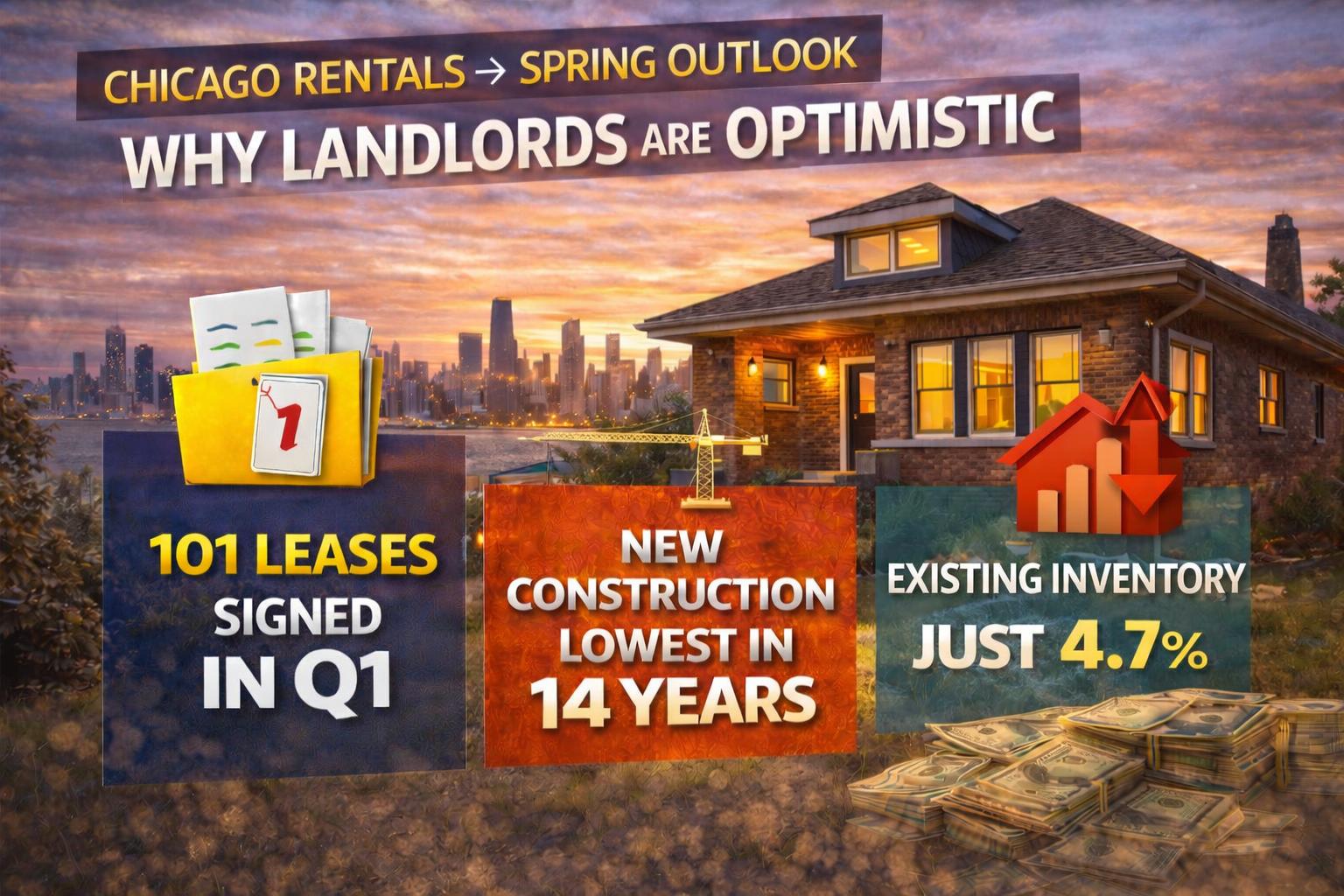
Q1 is the market's truth teller. It is the quarter where demand is least forgiving, where overpriced units sit and correctly priced units move. When the slowest quarter of the year produces 101 leases, an average of 6 applications per listing, and multiple units closing above asking rent, it is a signal worth paying attention to. Here is what the broader market data says about why the momentum behind that Q1 performance is not going away.
New Construction Is at a 14-Year Low
The most important structural story in the Chicagoland rental market right now is supply. According to a Marcus and Millichap 2026 forecast, multifamily deliveries across the Chicago area are expected to come in below 4,000 units this year, the lowest level since 2012. The Chicagoland Apartment Association reported that across 2025, 2026, and 2027 combined, the total number of new downtown apartment deliveries will not exceed 3,000 units. For context, developers were routinely producing that many units in a single year during the prior decade.
New construction starts have fallen approximately 40% from 2024 levels, driven by elevated interest rates and rising construction costs that continue to make new ground-up development difficult to underwrite. The pipeline that was already thin is getting thinner. According to CoStar data from Q3 2025, only about 11,000 units were under construction across the entire Chicago metro area, representing just 1.9% of total inventory, the lowest share since 2012.
The result of this constrained supply is a vacancy rate of 4.7% across the metro, roughly 200 basis points below the national average of 8.4%, with annual rent growth running at 3.4%, well ahead of the national pace. The Chicagoland Apartment Association put it plainly: as demand remains high and supply stays stubbornly low, rent increases are inevitable. Chicago now ranks among the top three metropolitan areas in the country for housing underproduction, with a shortfall estimated at approximately 165,000 units.
The For-Sale Market Is Keeping Renters Renting
The second force working in favor of Chicagoland landlords and investors is what is happening on the for-sale side of the market. Single-family home inventory across the Chicago metro declined approximately 20% year-over-year heading into 2026. Condo inventory fell between 18% and 26% depending on the segment. Illinois REALTORS reported that home sales statewide in February 2026 were down 5.9% compared to the prior year, with prices continuing to climb.
The median home price in the Chicagoland area sits at approximately $365,000 as of early 2026, and mortgage rates remain in the low-to-mid 6% range. For a significant portion of renters who might otherwise be buyers, the math does not work. The monthly payment on a median-priced Chicagoland home at current rates is meaningfully higher than what most of those same renters are paying in rent, and the inventory of entry-level homes they could realistically afford is not there. Renters who want to buy are staying renters longer than they expected, and that renter pool is adding directly to demand for quality rental housing across both the city and the suburbs.
What This Means for Spring 2026
For investors who own rental property in the Chicagoland market, the setup heading into Q2 and Q3 2026 is as favorable as it has been in years. Demand is strong. Supply is historically constrained. The for-sale market is funneling renters back into the rental pool. And the GC Realty Q1 data shows that even during the slowest leasing quarter of the year, well-managed and correctly priced properties are moving quickly and in some cases above asking.
Spring is when leasing velocity peaks. If Q1 produced the results it did under the most difficult seasonal conditions of the year, the units entering the market in April, May, and June are doing so into a significantly stronger demand environment. That is good news for owners who price correctly from day one. It is also a warning for owners who enter spring with inflated rents based on what their unit commanded in August or September of last year. The market is strong, but it is not forgiving of overpricing, a pattern the Q1 data made clear regardless of how active the broader market is.
The opportunity in spring 2026 is real. The investors who capture it will be the ones who come in priced right, show well, and move fast when qualified applicants appear. The ones who hold out for numbers the market will not support will watch that opportunity pass while their vacancy costs compound.
Don't Go At This Alone
This is a lot of information you need to know if you plan to invest here in the Chicago market and it may seem overwhelming, but real estate investing in Chicago is a team sport. Who is on your real estate investing team? Do you have a team? GC Realty and Development has a team of resources and we are willing to share all of our 20-plus years of experience in both real estate investing and property management in the Chicago market. We will do this whether you hire us or not.
Based on everything the data is showing, right now is a good time to be a Chicago landlord and a good time to be looking at buying rental property in this market. Limited supply, strong demand, renters staying in place longer, and rent growth that is outpacing the national average all point in the same direction. If you are not sure how to find a good deal or where to start evaluating an investment, reach out to us. That is exactly the kind of conversation we have every day and we are happy to be a resource regardless of where you are in the process.
What gets me up in the morning and keeps me going 12-plus hours a day is the ability to add value to Chicago real estate investors. If we connect you will hear me say our goal as a company is to have value for everyone we come in contact with, and in return we hope one day you will hire us for our Tenant Placement or Property Management Services. You can also refer us to someone you know that needs those services, or I will take a simple 5-Star Google review. We love the opportunity when we get all three from the current and aspiring investors we get to help.