

 Vendor Portal


Author: Mark Ainely | Partner GC Realty & Development & Co-Host Straight Up Chicago Investor Podcast
We have been managing rentals in Chicagoland since 2003 along with being an investor myself and this is a topic that comes up every year around this time. Tenants turn the thermostat up for the first time since spring, and many furnace or boiler system just dont operate as they are supposed to. This means, you as the Landlord have specific and sometimes legal obligation to prepare or respond.
Today our team manages about 1,500 units across Chicago and more than 100 suburbs, and a no heat call is one of the few work orders we treat as an emergency every single time. I do not care what unit it is or what hour it is. I learned a long time ago that in Chicago and suburban Cook County, the law starts a clock the minute your tenant tells you the heat is out, and that clock does not care whether your HVAC guy is booked. I want to walk you through what the ordinances actually say, what your tenants can do if you miss it, and how I handle a dead boiler because it will happen to you sooner or later if you do this long enough.
Key Takeaways
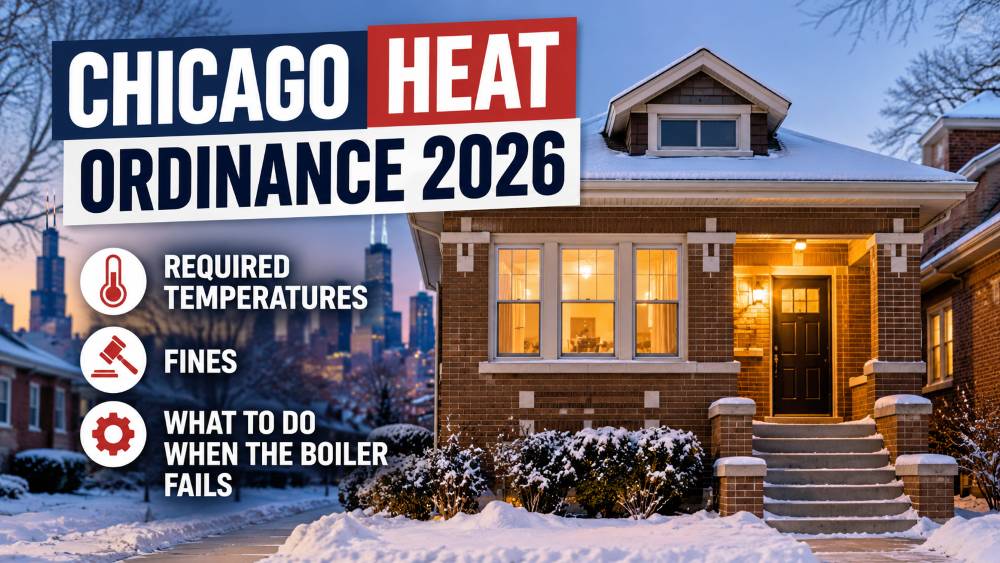
- Chicago heat season runs September 15 through June 1. Units must hold at least 68 degrees from 8.30 a.m. to 10.30 p.m. and at least 66 degrees overnight.
- The City can fine $500 to $1,000 per day, per violation, and the reason the heat is out does not matter.
- Under both the Chicago RLTO and the Cook County RTLO, heat is an essential service. Tenants can start using remedies 24 hours after written notice.
- Outside those ordinances, every Illinois tenant still has the implied warranty of habitability, and most suburbs enforce their own property maintenance codes.
- Speed and documentation are your best legal protection when a boiler fails.
What the Chicago Heat Ordinance Requires
From September 15 through June 1, any Chicago rental where the tenant does not control the heat must stay at 68 degrees from 8.30 a.m. to 10.30 p.m. and 66 degrees from 10.30 p.m. to 8.30 a.m. That applies in every habitable room, bathroom, and toilet room with the windows and doors closed. Where each unit has its own furnace, that equipment has to be capable of holding 68 degrees.
The Department of Buildings enforces it with fines of $500 to $1,000 per day, per violation. The Chicago Bar Association notes that if a boiler takes out heat in six units, the fine hits each of those six units. Portable heaters do not count as compliance.
Landlords must be super responsive to these issues because Tenants can easily report through 311, and the City brings roughly 300 to 500 heat cases a year. In bad cold snaps, housing court judges have appointed receivers to take over buildings and restore heat using the rent.
Chicago RLTO Remedies When the Heat Fails
The fines come from the City. The bigger exposure usually comes from the tenant. Under the Chicago Residential Landlord and Tenant Ordinance, once a tenant gives written notice of no heat, they can:
- Buy heat themselves and deduct the receipted cost from rent(rare but I have seen it happen)
- Sue for the reduced fair rental value of the unit
- Move into substitute housing and recover the cost, capped at their monthly rent
- Withhold a reasonable portion of rent if the problem is not fixed within 24 hours
- Terminate the lease if the problem runs past 72 hours after notice
I have seen owners hand back more in rent credits than the repair itself cost, simply because the tenant knew the rules and the owner did not. Twenty four hours is not much time to get a boiler tech out, diagnose a bad control board, and track down a part in the middle of January.
These are the moments where having a good rapport with your tenants makes the difference between them calling 311 or working with you to keep the scenario amongst yourselves to solve and make right.
Suburban Cook County RTLO Heat Rules
The Cook County Residential Tenant Landlord Ordinance copies Chicago's numbers. Adequate heat means 68 degrees by day and 66 overnight from September 15 through June 1, and heat is listed as an essential service alongside water, electricity, gas, and plumbing.
The County's own summary lays out the tenant remedies after written notice. After 24 hours, the tenant can withhold a reasonable portion of rent, pay for the service and deduct it, recover damages and attorney fees, or make the landlord cover substitute housing. After 72 hours, they can end the lease and move out within 30 days. None of that applies if the tenant or the utility caused the outage.
The RTLO exempts owner occupied buildings of six units or fewer, plus a single family home or condo when it is the owner's only rental and they lived there within the past year. Everyone else in suburban Cook is covered.
I talk to a lot of suburban owners who assume the heat rules are a Chicago thing. They are not. If you own in Des Plaines, Schaumburg, or Oak Lawn and you are not exempt, you are living under the same 24 hour clock as an owner in Logan Square. This is mostly because the Cook County RTLO is still relatively new and many investors are not aware it even exists. (Check out RTLO vs RLTO)
Illinois State Law and the Rest of Chicagoland
Illinois has no single statewide heat temperature for rentals. That does not mean you are off the hook in DuPage, Kane, or Will. Since Glasoe v. Trinkle in 1985, every residential lease in Illinois carries an implied warranty of habitability, and a unit with no heat in January is not habitable. A tenant can use that as a defense to an eviction for nonpayment.
Most suburbs also adopt the International Property Maintenance Code, which generally requires habitable rooms to reach 68 degrees during a heating season the town sets. Evanston and Oak Park run their own landlord tenant ordinances on top of that. Check the municipal code for every town you own in, because the dates and inspection rules vary.
One more state rule worth knowing. Under the Rental Property Utility Service Act, if an owner stops paying a utility bill the tenants rely on, the tenants can pay it and deduct it from rent.
What to Do When the Heat Goes Down
In more than 20 years I have never had a winter without at least one boiler going out. What you can control is how fast you move and what your paper trail looks like when an inspector or a judge asks about it. This is exactly how my team runs a no heat call.
- We start before September 15. Every boiler and furnace gets fired up in late August or first couple of weeks of September, radiators get bled, thermostats get tested, and we keep the service report. Most of the failures I see that first cold week are things a tune up would have caught.
- We tell tenants how to report it. The 24 hour emergency line is in the lease packet, and we send a reminder when heat season starts. A tenant who can reach you has no reason to call 311.
- We respond in hours, not days. We log when the call came in, when the tech arrived, and the temperature readings, with photos of the thermometer.
- We bring a bridge. UL listed space heaters go out the same day. They do not satisfy the ordinance, but they keep the tenant safe, keep the pipes from freezing, and show good faith.
- We offer the hotel first. If the repair is going to run past 24 hours, we may offer a hotel or a written rent credit before the tenant asks.
- We update in writing. Every status change goes out by text or email, from parts ordered to the new ETA. In my experience, silence is what turns a frustrated tenant into a 311 complaint.
- We have backup vendors. In a cold snap your boiler company is booked for days. Know who your second and third call are before you need them.
FAQ
When does Chicago heat season start in 2026? September 15, and it runs through June 1, 2027. Suburban Cook County uses the same dates under the RTLO.
Can a tenant withhold rent when the heat is out? Yes. In Chicago and suburban Cook, a tenant who gives written notice can withhold a reasonable portion of rent if the heat is not restored within 24 hours.
Do space heaters count as compliance? No. They are a temporary bridge while the heating system is repaired, not a substitute for it.
What if the tenant caused the outage? The Cook County RTLO remedies do not apply when the tenant or the utility caused the condition. Document the cause in writing with your tech's report.
Don't Go At This Alone!
A boiler that dies at 2 a.m. in January is the moment a lot of self managing owners realize how much they are carrying alone. When you work with us, that call comes to my team instead of to you. We run pre season heat checks, staff a 24 hour emergency line, and document every no heat call from the first report to the final repair across the roughly 1,500 units we manage. Your tenants stay warm, and your file is clean if the City or a court ever comes asking.
Related resources