

 Vendor Portal

Author: Mark Ainely | Partner GC Realty & Development & Co-Host Straight Up Chicago Investor Podcast
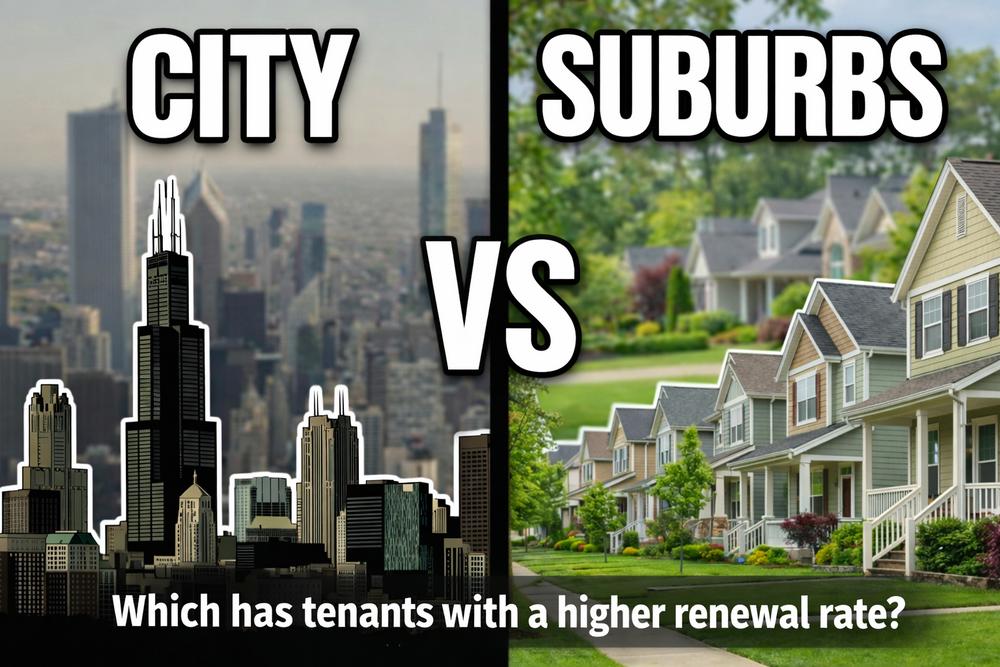
Every Chicago investor has had this debate. City or suburbs? More cash flow in the city, more stability in the suburbs. Better tenants out west, down south, more demand downtown. Everyone’s got a theory.
We’ve got 1,019 lease expirations from 2025. So instead of debating, let’s look at what actually happened.
The Retention Numbers
Chicago (City): 71.9% renewal rate (297 renewed out of 413 leases)
Suburbs: 70.7% renewal rate (524 renewed out of 741 leases)
That’s it. About one percentage point apart. If you’ve been choosing between city and suburbs based on tenant retention, the data says you’re overthinking it. Tenants are staying at nearly the same rate in both markets.
But the story gets more interesting when you look at what landlords are charging to get those renewals.
The Rent Increase Gap
While retention was a virtual tie, rent increases told a different story:
Chicago average increase: 7.6%
Suburbs average increase: 6.8%
That gap gets even wider at the high end. In Chicago, nearly 24% of renewed leases had increases above 10%. In the suburbs, that number was just under 16%. City landlords are pushing harder on rent, and tenants are absorbing it.
On the flip side, suburban renewals were more concentrated in the moderate range. About 41% of suburban increases fell between 0.1–5%, compared to 35% in the city. Suburban landlords are taking a steadier, more conservative approach, and getting essentially the same retention result.
Location Helps, The Right Resident Makes the Difference
Whether you own in the city or the suburbs, long-term success starts with proper screening. Our Mastering Tenant Screening Guide walks you through how to find stable, reliable tenants in any market.
👉 Download the Guide Here:
https://www.gcrealtyinc.com/chicago-tenant-screening-mastery-guide
First Half vs. Second Half: A Shift in Strategy
When we split the year in half, an interesting pattern emerges. Overall, average rent increases dropped from 7.5% in the first half of 2025 to 6.3% in the second half. But that headline number hides what was really going on.
City landlords didn't flinch. Chicago's average increase actually ticked up slightly from 7.5% to 7.7% in the second half; nearly a quarter of city renewals in both halves came with increases above 10%. The city market stayed aggressive all year.
The suburbs told a different story. Average increases dropped from 7.5% in the first half to 5.7% in the second half, a meaningful pullback. And the share of suburban renewals with increases above 10% fell from 18.2% to just 11.8%.
What did suburban landlords get in return? Better retention. Suburban renewal rates climbed from 67.5% in the first half to 76.1% in the second half. Whether that was cause and effect or seasonal timing, the correlation is hard to ignore.
The takeaway: the Chicago city market appears to have more pricing power throughout the year, while suburban landlords may benefit from a more measured approach, especially heading into the back half of the year when tenants are less inclined to move.
Why City Landlords Can Push Harder
Chicago’s rental market has some built-in advantages for landlords when it comes to pricing power. Demand stays strong across most city neighborhoods, and tenants know it. When a tenant in Logan Square or Bridgeport looks at what else is available at their price point, they often realize they’re already getting a fair deal, even after an increase.
There’s also a convenience factor. City tenants have typically built their lives around their location, commute routes, favorite spots, proximity to friends and family. Moving across the city isn’t like moving across a suburb where one town feels like the next. In Chicago, every neighborhood has its own identity, and leaving one means adjusting your entire routine.
That emotional attachment to a neighborhood gives city landlords more room to raise rents without triggering a move.
The Suburban Advantage
Suburbs may not offer the same aggressive rent growth, but they come with their own retention advantages. School districts are a major anchor, families who’ve gotten their kids into a good district aren’t leaving over a 5% increase. The suburban tenant pool tends to skew older, more established, and more rooted in their community.
There’s also less competition from new construction in many suburban markets compared to the city, where new apartment buildings are constantly adding inventory. A single-family rental in Geneva or Crystal Lake doesn’t compete with a new high-rise the way a city unit might.
The trade-off is real: suburban landlords get reliable retention with moderate increases, while city landlords get the same retention with stronger rent growth—but potentially more competition long-term as new supply comes online.
So Which Is Better?
If your primary concern is tenant retention, the data says it doesn’t matter much. A 1.2 percentage point difference is noise, not a trend. Both markets are retaining tenants in the low 70s, which is well above the Chicago metro average of 61.1% and the national average of 54–55%.
If your focus is rent growth, the city has the edge right now. Chicago landlords are getting bigger increases while holding the same tenants. But that advantage comes with a caveat, new construction in the city is something suburban landlords rarely have to worry about, and concessions from newer buildings can erode your pricing power faster than you’d expect.
The real answer, as always, comes down to your investment goals, your risk tolerance, and how well the property is managed. A well-run suburban rental and a well-run city rental are both going to retain tenants. The data backs that up.
What the data also backs up: the grass isn’t always greener on the other side of the city limits. If you’ve been second-guessing your market, stop. Focus on the fundamentals, responsive management, fair pricing, well-maintained units, and the retention will follow regardless of the zip code.
Wondering Where to Invest Next?
Whether you’re a city investor eyeing the suburbs or a suburban landlord curious about Chicago proper, we’ve managed properties across both markets for 20+ years. GC Realty & Development can help you evaluate opportunities, compare markets, and figure out where your next investment dollar works hardest. Download our Where To Invest In The Chicago Market
Don’t Go At This Alone
This is a lot of information you need to know if you plan to invest here in the Chicago market and it may seem overwhelming but real estate investing in Chicago is a team sport. Who is on your real estate investing team? Do you have a team? GC Realty & Development has a team of resources and we are willing to share all of our 20+ years of experience in both real estate investing and Property Management in the Chicago market. We will do this whether you hire us or not.
What gets me up in the morning and keeps me going 12+ hours a day of work is the ability to add value to Chicago real estate investors. If we connect you will here my say our goal of our company is to have value to have everyone we come in contact with and in return we hope one day you will hire us for our Tenant Placement or Property Management Services You can also refer us to someone you know that needs Tenant Placement or Property Management Services, or I will take a simple 5 Star Google review. We love the opportunity when we get all three from current and aspiring investors we get to help!
Reach out today!

Partner / Co-Host of Straight Up Chicago Investor Podcast