

 Vendor Portal

Author: Mark Ainely | Partner GC Realty & Development & Co-Host Straight Up Chicago Investor Podcast
Recently, my team and I have been getting a steady stream of property management inquiries from Chicago investors, both in the city and out in suburban Cook County, who all have some version of the same problem. They have an eviction that has been going on forever. And these are not owners sitting on their hands. They have been aggressive at every step, doing what they are supposed to do, and the case still will not move. After hearing the same story enough times, it got me wondering what has actually changed. So I dug into the current process, the court programs, and the sheriff timelines, and I want to walk you through what is really going on.
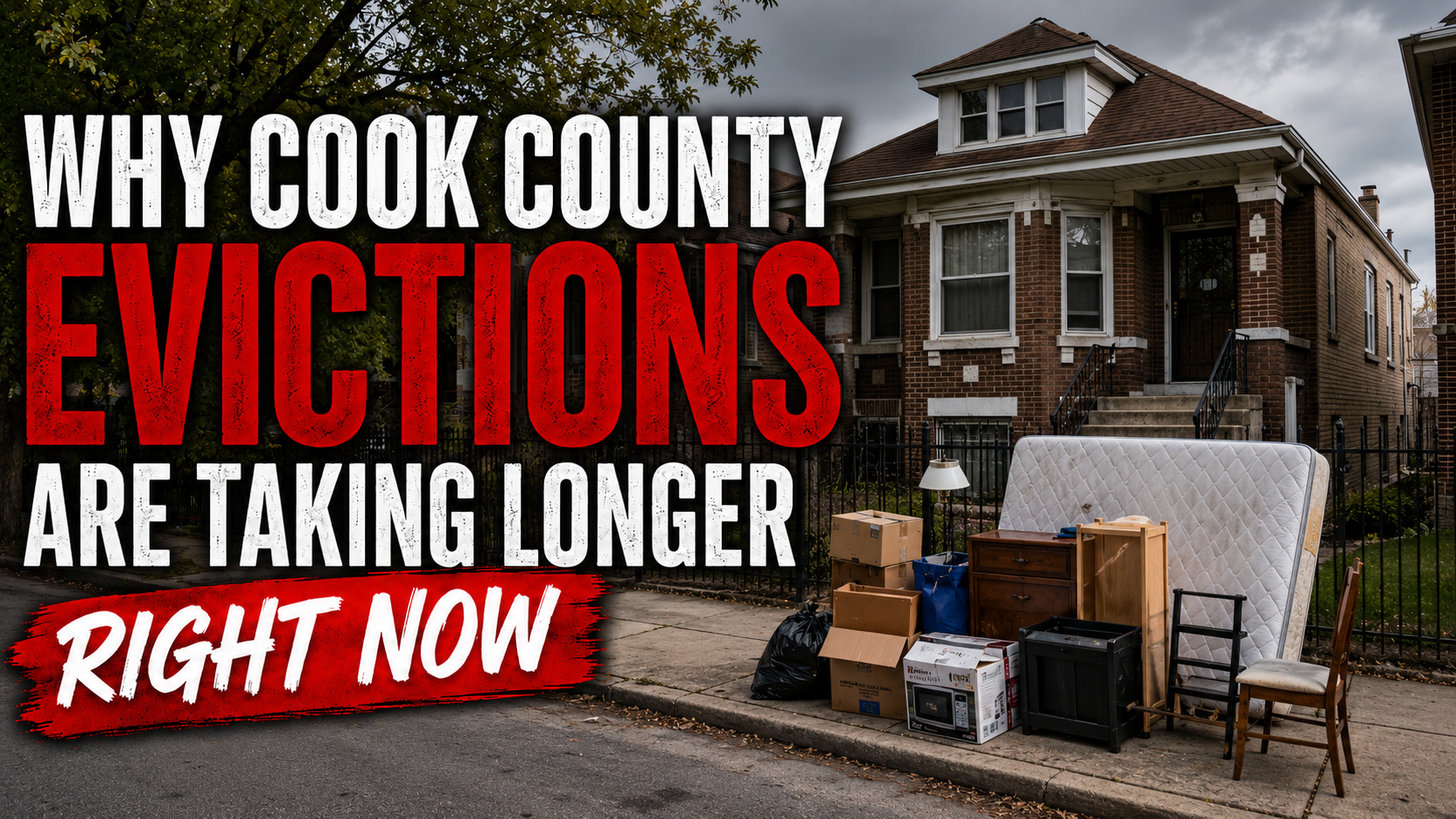
The bottom line up front. Evictions in Chicago and Cook County are taking longer than they used to, and if it feels like your case is stuck, you are not imagining it and you are probably not doing anything wrong. A process that a lot of investors still picture as a quick 60 day fix now stretches into months, and inside the city it can eat up close to half a year before you get your unit back.
One thing to get straight right away. This is a courtroom delay, not a sheriff delay. I hear owners blame the Sheriff's Office all the time, but once you actually have your Order for Possession in hand, the sheriff usually moves within a few weeks. The months pile up before that, inside the court process itself. That is where we need to focus.
Key Takeaways
- A Cook County eviction now runs roughly five to seven months from start to finish, and that includes both Chicago and suburban Cook County. The collar counties like DuPage and Kane move faster, often in the neighborhood of ten weeks.
- The delay is in the courtroom, not at the Sheriff's Office. Once you have your Order for Possession, the sheriff usually enforces within a few weeks. The time stacks up before that.
- The Early Resolution Program builds an automatic continuance into almost every case. Chicago cases usually get about 28 days at the first appearance and suburban Cook cases usually get about 14 days.
- Contested cases are waiting even longer right now. Our eviction attorney reports that trials beyond mediation are being set six to seven weeks out, rather than the usual two to four weeks.
- Rental assistance applications can take one to three months to approve and pay out, which stalls cases in the middle.
- For nonpayment, you can start fast. With a Chicago Association of Realtors lease you can serve a five day notice the day after rent is due, so waiting 45 to 90 days to file is self inflicted delay. The 30, 60, and 120 day Fair Notice periods apply to ending a tenancy, not to nonpayment.
- The winter moratorium and cold weather pauses are the main sheriff side exception. They can create a spring backlog, but they are seasonal, not the everyday driver.
- You cannot control the courts, but you can control your screening, your notices, and your paperwork. That is where good systems save you real money.
How Long Are We Talking
Right now, if you file an eviction anywhere in Cook County, whether inside the city of Chicago or out in suburban Cook, plan on roughly five to seven months from the day you file to the day the sheriff hands you back possession. Some cases move faster and plenty move slower. Attorneys who file these cases every single week will tell you the same range. This is a Cook County problem, so do not assume the Cook suburbs are immune. The collar counties like DuPage, Kane, and Will are the ones that move meaningfully quicker, often around ten weeks, because those cases run under state law without the extra Cook County and Chicago layers.
And here is the part that trips people up. Almost all of that time is the court process. The sheriff's physical eviction, once you actually have your order, usually happens within a few weeks. So when a case drags, the holdup is almost always in the courtroom or in the steps leading up to it, not at the Sheriff's Office.
Let me break the timeline into the pieces that actually eat the calendar, because once you see where the time goes, the delays make a lot more sense.
Piece One: When You Can Actually File (And Why Most Landlords Wait Too Long)
Before I get into the delays that really are outside your control, I want to point out what is controllable first. This one has nothing to do with the current court slowdowns. It is a mistake I have watched landlords create for themselves for years, long before any of these backlogs existed, and it is the single easiest place to win time back. For a standard nonpayment situation, rent is due on the first and it is legally late on the second. Do not confuse that with the five day grace period for late fees. Those are two completely different things. The grace period only controls when you are allowed to tack on a late fee. It has nothing to do with when the rent is actually late or when you can start the eviction process. If you are using a Chicago Association of Realtors lease, you can serve a five day notice to pay the very next day after rent is due. You do not have to wait until the fifth, and you do not have to wait for the late fee window to close.
Here is why that matters so much. Once you serve that five day notice and the five days pass without payment, you can file. In practice, a nonpayment case can be on file a little over a week after the rent was due if you actually move on it. Yet I constantly see owners sit on a nonpayment for 45 to 90 days before they serve anything, hoping the tenant catches up or just trying to avoid the awkward conversation. That is pure lost time you are volunteering, and you never get it back once the courts pile their own delays on top. The single fastest way to shorten your eviction is to start the clock the day the rent is late, not weeks or months later.
One important distinction, because it trips people up constantly. The longer notice periods you may have heard about under Chicago's Fair Notice Ordinance, 30 days, 60 days, or a full 120 days, are a separate animal. Those apply when you are ending a tenancy or choosing not to renew a lease with no fault by the tenant, and the length depends on how long they have lived there. They do not apply to a nonpayment eviction. If your tenant simply is not paying, you are on the five day notice track, not the 120 day track. Knowing which path you are actually on is what keeps you from waiting months you never needed to wait.
Piece Two: The First Court Date And The Early Resolution Program
Once you file, you wait for a first court date, which is generally 30 to 60 days out. Here is the biggest change from the old days. Cook County runs an Early Resolution Program that was created during the pandemic and is now a permanent fixture. At the first appearance, the tenant gets an automatic continuance and gets connected to free legal advice, mediation, and rental assistance. In the city, that first continuance is usually about 28 days. In suburban Cook County it is usually about 14 days. The Chicago Bar Foundation, which helps run the program, has estimated that these changes add somewhere between six weeks and two months or more to the court process. That is by design. The goal is to give tenants a real shot at resolving things without a judgment. For you as the owner, it simply means more time before you can move forward.
One front end tip that lives on this side of the process too. As of 2025, you are no longer required to use the sheriff first to serve the initial summons. You can start with a licensed private process server, which can speed up the front end of your case, since sheriff service only succeeds roughly 40 percent of the time and a failed service attempt means asking for another court date.
There is also a timely wrinkle worth flagging, straight from the front lines. Our eviction attorney, Tom Raleigh of the Halsted Law Group, recently gave me a heads up on a temporary change that is stretching contested cases out even further right now. When a case does not settle in mediation and heads to trial, the trial date is landing much further out than it used to. Here is how he put it:
Chicago landlords and property managers should be aware of a temporary change in the eviction process that could significantly affect the timeline for contested eviction cases. Chicago's eviction courtrooms are currently experiencing longer delays when scheduling trials. Cases that proceed beyond mediation are now frequently being set for trial six to seven weeks later, rather than the more typical two to four week timeframe.
Tom Raleigh, Halsted Law Group
In plain terms, if your tenant fights the case, you could wait an extra month or more just to get a trial date, on top of everything else in the process. For a contested eviction, that gap alone can be the difference between a spring turnover and a summer one, which is exactly why the total timeline is creeping toward that seven month end of the range.
One more thing, and it matters even if you are not dealing with an eviction right now. The best time to get an attorney like Tom in your corner is before you need one, not the week a tenant stops paying. You can talk to Tom Raleigh directly and build out the rest of your investing team through our Straight Up Chicago Investor Build Your Team page.
Piece Three: Right To Counsel And More Represented Tenants
Layered on top of the Early Resolution Program is Chicago's Right to Counsel program, which provides free attorneys to income qualified tenants facing eviction in the city. Pairing a tenant with an attorney takes time, and a represented tenant is far more likely to raise defenses, ask for additional dates, or negotiate a longer move out. The data backs this up. In Chicago, represented tenants have been more than twice as likely to get their cases dismissed, and the rate of landlord possession awards drops sharply once a tenant has a lawyer. For years, the large majority of tenants showed up with no lawyer at all. That is changing, and represented cases run longer. Worth noting for anyone following the politics: the push to make Right to Counsel permanent has now been folded into the Protecting Renters Ordinance, the broader tenant protection package that the City Council Committee on Housing and Real Estate is actively reviewing as of this month. No full council vote has happened yet, but the direction of travel in Chicago is clearly toward more tenant representation, not less.
Piece Four: Rental Assistance Timing
A big reason cases stall in the middle is rental assistance. Tenants in eviction court can apply for court based rental assistance, and Illinois has offered up to $25,000 per household through the state housing authority program. When a tenant has an application pending, judges will often continue the case to let it play out. The catch is that getting approved and getting the money into the landlord's hands can take one to three months. That money is real and it can make you whole, which is a good outcome, but it also stretches the timeline while everyone waits on the check.
I will be honest about how this stretch feels, because it is one of the most stressful parts of the whole process. When you are waiting on rental assistance, you can see a real light at the end of the tunnel. There is a genuine chance you recoup the past due rent and maybe even come out 100 percent whole. But it can still all fall apart, and you are left wondering whether you should keep pushing the case hard or give the assistance time to come through. Here is my honest opinion after watching this play out many times. If you have a communicative tenant who stays engaged and responsive, your odds of the rental assistance actually landing go up ten fold compared to a tenant who has gone quiet on you. So how you play that waiting period depends a lot on whether your tenant is working with you or ignoring you.
Cook County Sheriff Time Frames
This is where I want to correct the most common assumption I hear. Once you win your case and place your Order for Possession with the Cook County Sheriff, enforcement is generally quick. The sheriff can technically act as soon as 24 hours after the order is placed, and in practice most owners see the physical eviction happen within a few weeks. You get a phone call the day before with a time block. The sheriff is not where your months are disappearing.
There is one real exception, and it is seasonal. Every winter the sheriff pauses enforcement over the holidays. This past cycle that ran from December 19, 2025 through January 5, 2026, with enforcement resuming on January 6. On top of that, the sheriff will not carry out an eviction on any day the temperature hits 15 degrees or below, or during extreme weather. In a Chicago winter that adds up, and those paused cases stack into the spring. So if you win a judgment in December or January, plan on a slower enforcement window. The rest of the year, the sheriff step is the fast part.
The other thing that can stall enforcement is your own paperwork. A wrong unit number, a missing key to a common door, more people living in the unit than you named on your filing, or a tenant motion filed within 30 days of the order can all send you back to the end of the line. None of that is the sheriff being slow. It is avoidable when your file is clean.
Cook County Eviction Volume
Some context helps explain the congestion. Before the pandemic, Chicago courts saw around 18,000 eviction filings a year. Filings dropped after the moratorium ended, with about 12,000 filed in 2024, and more than 40,000 cases have been filed across Cook County since April of 2022. Even with volume below the old normal, the added steps in each case mean the system simply moves slower per case than it did five or six years ago.
What This Actually Costs You
Here is the part I always come back to with our clients. Every one of these weeks is money. If you are not collecting rent for five, six, or seven months while a case grinds through the process, plus legal fees that commonly run one to two thousand dollars, plus the turn costs once you finally get the unit back, a single bad tenant can wipe out a full year of profit on that unit. For a smaller owner with a couple of units, that is not an inconvenience. That is the difference between a good year and a painful one. This is exactly why the money is made or lost long before you ever file.
What You Can Actually Do About It
You cannot speed up the courts. You can control almost everything that leads up to them.
- Screen like your returns depend on it, because they do. The cheapest eviction is the one you never have to file.
- Serve your notices correctly and on time. A defective notice gets your case tossed and you start the whole clock over.
- File promptly. Rent is late the day after it is due, so serve your five day notice then, not weeks later. Sitting on a nonpayment for 45 to 90 days is time you never get back once the courts add their own delays.
- Get your sheriff paperwork perfect. Name every leaseholder plus any and all unknown occupants, confirm the exact unit number, and have keys to every common area and the unit.
- Budget for delays. Assume months, not weeks, and keep reserves so a slow case does not force you into a bad decision.
- Consider a private process server for faster, more reliable service on the front end of your case.
- Lean on professionals who do this every week and know the local judges, the paperwork, and the timing.
FREE DOWNLOAD: SCREENING MASTERY
Want the exact process we use to screen over 2,000 tenant applications every year in Chicago? Grab our free screening playbook so you place a quality resident the first time and keep yourself out of eviction court.
Download Tenant Screening Mastery Guide
At the end of the day, the best eviction strategy is never needing one, and that starts long before a lease is even signed. Price your unit right and you pull from a bigger, stronger pool of applicants instead of scraping the bottom on a unit that has sat too long. Then screen that pool hard and put a quality resident in place. Price it right, screen it right, and you avoid almost everything you just read about.
Frequently Asked Questions
How long does an eviction take in Chicago right now?
Plan on roughly five to seven months from filing to getting possession back, though it varies case by case. This holds across Cook County, including suburban Cook, since it is all one court system. The collar counties like DuPage and Kane are the ones that are generally faster.
How soon can I file an eviction for nonpayment?
Faster than most owners think. Rent is due on the first and late on the second, and that is separate from the five day grace period for late fees. With a Chicago Association of Realtors lease you can serve a five day notice the day after rent is due, and once those five days pass without payment you can file. Do not confuse a nonpayment case with the 30, 60, or 120 day Fair Notice periods, which apply to ending a tenancy, not to nonpayment.
Is the delay the sheriff or the court?
Mostly the court. Once you have your Order for Possession, the sheriff typically enforces within a few weeks, and can act as soon as 24 hours after the order is placed. The months accumulate before that, in the notice period and the court process. The main sheriff side exception is winter, when enforcement pauses over the holidays and on very cold days.
Does the winter moratorium stop me from filing?
No. The moratorium only pauses the sheriff's physical enforcement of evictions. You can still file your case, go to court, and get a judgment during the winter. It is the last step, the lockout, that waits.
Can I speed up service of the summons?
Yes. As of 2025 you are no longer required to use the sheriff first. You can start with a licensed private process server, which is often faster and more reliable than sheriff service.
Is the eviction timeline different in DuPage County?
Yes. The collar counties like DuPage, Kane, Lake, and Will sit outside Cook County and run under Illinois state law without the Cook County and Chicago layers, so cases generally move faster. A collar county case can run closer to ten weeks, compared to roughly five to seven months anywhere in Cook County, which includes both Chicago and suburban Cook.
What is the single biggest thing I can control?
Tenant screening and clean paperwork. You cannot control the courts, but strong screening keeps you out of eviction court in the first place, and accurate notices and sheriff filings keep the case you do file from getting delayed or dismissed.
Don't Go At This Alone!
The eviction process in Chicago and Cook County is not something you want to learn on the fly with your own money on the line. At GC Realty & Development, we manage roughly 1,500 units across the Chicagoland area, and we deal with these timelines, these courtrooms, and these sheriff filings every single week. We know how to keep a case clean so it does not get bounced, how to position a file for rental assistance when that makes sense, and how to get you back to collecting rent as fast as the system will allow. More importantly, we know how to price your unit right and place the right resident in the first place so you never end up here.
My mission is simple. I want to help you buy your time back and lower your risk, so you can enjoy the benefits of owning real estate without it running your life. That is what we do for our owners every day, and it is why I keep putting content like this out into the Chicagoland investor community.
If you are staring down a problem tenant, or you just want a partner who handles this so you do not have to, let's talk.