

 Vendor Portal

Author: Mark Ainely | Partner GC Realty & Development & Co-Host Straight Up Chicago Investor Podcast
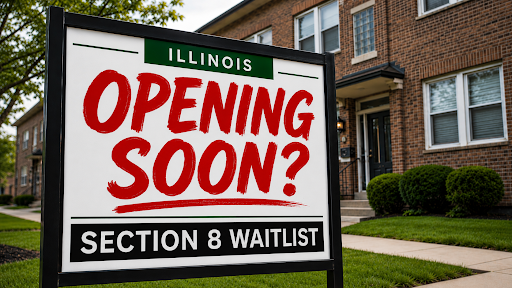
After managing rental property in Illinois for over two decades, I've lost count of how many times I've gotten some version of this question, from a prospective tenant, a fellow investor, or my own leasing agents: "How many people are on the Section 8 waiting list, and when does that open?" My honest answer is almost always the same: it depends which one.
That answer confuses people, and I get why. Most renters and even a lot of landlords assume Section 8 works like a DMV line: one statewide list, everybody waits their turn, done. It doesn't work that way in Illinois, and understanding the real structure matters whether you're a tenant trying to get housing assistance or a landlord trying to decide whether accepting vouchers is worth it for your units.
There Is No Single Illinois Section 8 Waiting List
Section 8, officially the Housing Choice Voucher program, is administered locally. Illinois has over 100 separate Public Housing Authorities (PHAs), and each one runs its own waiting list, on its own schedule, with its own preferences and eligibility rules. There is no statewide waiting list and no single application that gets you onto every list at once.
Some of those PHAs are organized by municipality (the Chicago Housing Authority serves the city of Chicago), some are organized by county (the Housing Authority of Cook County serves suburban Cook County outside city limits, and DuPage County and Lake County each have their own housing authority), and some cover smaller regional service areas entirely on their own. So the honest short answer to "is it a county thing or a PHA thing" is: it's a PHA thing, and PHA boundaries sometimes line up with a county and sometimes don't.
This is exactly why applying to only one waiting list is a mistake for tenants, and why it's worth landlords knowing the difference between the PHAs operating in their specific market.
Chicago Section 8 Interesting Facts
The scale of these programs surprises most people, landlords included. Statewide, Illinois currently has more than 225,000 families receiving Section 8 rental assistance, spread across those 100+ separate PHAs.
Here's how that breaks down for three of the agencies most relevant to our market:
Chicago Housing Authority (CHA): Roughly 47,000 families are currently receiving HCV or Project-Based Voucher assistance citywide, covering about 108,000 individuals total. CHA pays out approximately $648 million in rental assistance annually.
Housing Authority of Cook County (HACC): More than 15,000 voucher holding households across the 108 suburban Cook County communities HACC serves.
DuPage Housing Authority (DHA): Roughly 3,300 households, a fraction of CHA's scale, reflecting DuPage's smaller renter population relative to Chicago.
That 47,000 figure at CHA is worth breaking down further, because it matters for how landlords should think about their own applicant pool. All 47,000 of those families are voucher program participants, meaning either standard tenant based Housing Choice Vouchers or Project Based Vouchers, and every one of them rents from a private property owner in the open market. That's separate and distinct from CHA's traditional public housing, which are roughly 21,000 units that CHA itself owns and operates directly. Residents in those buildings are CHA's own tenants, not applicants who will ever end up in a privately owned rental unit. In other words, the entire 47,000 figure is the pool landlords in our market are actually drawing from.
Recent list openings show just how lopsided demand can get relative to available spots. When CHA's main voucher list last opened for about a month in 2014, more than 280,000 people applied, up from 203,000 during the prior 2010 opening. When HACC reopened its voucher list in 2020 for the first time since 2001, it accepted applications for a two week window and selected 10,000 households by lottery for the list. DuPage's most recent opening, in May 2022, lasted a single day and closed once it reached 1,500 applications.
Key Takeaways
Illinois has no single, statewide Section 8 waiting list. More than 100 individual PHAs each run their own, serving over 225,000 families statewide combined.
Waiting lists are opened and closed at each PHA's discretion, often by lottery, and can open with very little public notice.
The Chicago Housing Authority's Housing Choice Voucher waitlist has been closed since a 2014 lottery, though its Public Housing and Project-Based Voucher lists remain continuously open.
Suburban Chicago PHAs like the Housing Authority of Cook County, DuPage Housing Authority, and Lake County Housing Authority open their lists only occasionally, sometimes years apart.
Wait times, once someone is on a list, commonly run anywhere from six months to five-plus years depending on the PHA and household size.
Illinois has prohibited source-of-income discrimination statewide since January 1, 2023, meaning landlords cannot legally reject an applicant solely for having a voucher.
For landlords, accepting vouchers means a guaranteed, PHA-paid portion of rent, a larger applicant pool, and a built-in unit inspection at move-in.
When Do These Lists Actually Open?
There's no predictable calendar here, and that's the part that trips people up. A PHA will open its waiting list, sometimes for a matter of days, sometimes indefinitely, then close it again once it has enough names to work through for the foreseeable future. Some PHAs run pure lotteries where applications submitted during the open window are drawn at random, so there's no advantage to being first in line the moment it opens. Others run first-come, first-served intake.
For a market like ours, that means the Chicago Housing Authority's main voucher list has sat closed since a 2014 lottery, while its Public Housing and Project-Based Voucher waitlists have stayed open the whole time. Meanwhile, DuPage Housing Authority's Housing Choice Voucher list last opened back in 2022, though it opens smaller Project-Based Voucher lists more frequently. The Housing Authority of Cook County and Lake County Housing Authority follow their own separate, irregular schedules.
The practical takeaway for anyone trying to track this: don't rely on word of mouth. Check directly with the specific PHA covering the property's location, and if you're helping a tenant, encourage them to apply to several PHAs at once rather than waiting on one.
What to Watch For Going Forward
A few developments right now are worth keeping on your radar, whether you're a landlord accepting vouchers or a tenant tracking a list.
No confirmed date for CHA's main voucher list to reopen. CHA's Housing Choice Voucher waitlist remains closed as of this writing, with no public timeline for reopening. When it does reopen, expect a public lottery announcement similar to 2014, not a quiet rolling intake. CHA's Public Housing, Project-Based Voucher, and PBRA waitlists stay open in the meantime.
A real HUD funding shortfall for 2026. HUD has flagged an estimated $700 million funding gap for the Housing Choice Voucher program nationally for federal fiscal year 2026. In practical terms, that can mean PHAs moving more cautiously on issuing new vouchers, tighter oversight of payment standards, and less appetite for reopening lists until funding stabilizes. Landlords already working with voucher tenants should keep an eye on any communication from their PHA about proration or funding-related delays in HAP payments.
New inspection standards are phasing in. HUD's National Standards for the Physical Inspection of Real Estate, known as NSPIRE, is replacing the older Housing Quality Standards used to approve voucher units. HUD has pushed back the compliance date for the HCV, Project-Based Voucher, and Mod Rehab programs multiple times, with the current target now January 31, 2027. Once it takes effect, inspections will score additional items landlords haven't had to think about before, including fire-rated doors, GFCI and AFCI electrical protection, guardrails, HVAC condition, and interior lighting. It's worth getting ahead of these standards on your units now rather than scrambling once scoring becomes mandatory.
Emergency Housing Vouchers are a separate, time-limited program. If any of your tenants hold an Emergency Housing Voucher rather than a standard HCV, know that Congress has not guaranteed funding for that program beyond 2026. Some households could face a transition off EHV assistance later this year, so it's worth confirming with your PHA which voucher type a given tenant holds.
None of this changes the underlying math for landlords: vouchers still mean a guaranteed government-paid portion of rent. But funding volatility at the federal level is exactly why staying in contact with your PHA, rather than assuming last year's rules still apply, matters more in 2026 than it has in years.
How Landlords Actually Benefit From Accepting Vouchers
I hear a lot of landlords write off Section 8 before they've looked at the mechanics, usually because of one bad-tenant story. The program has real structural advantages worth weighing property by property.
A guaranteed portion of rent, paid on time. The PHA pays its share directly to you regardless of what's happening in the tenant's life that month, and that payment doesn't depend on the tenant's job situation staying stable.
A larger, steadier applicant pool. Voucher holders add real depth to your applicant pool, particularly for smaller units and workforce price points where demand from voucher holders tends to be strong and consistent.
Built-in habitability inspections. Before a voucher tenant moves in, HUD requires the PHA to inspect the unit against Housing Quality Standards, a second set of eyes confirming the unit is move-in ready.
Legal clarity, not legal risk. Illinois made source-of-income a protected class statewide effective January 1, 2023, layered on top of a Cook County ordinance dating to 2013 and an even older City of Chicago ordinance. Landlords here can't legally screen out applicants for holding a voucher, so building your screening criteria around income, rental history, and background rather than voucher status keeps you compliant and actually widens your funnel.
None of that means every voucher tenant is a perfect fit. It means the program isn't the obstacle people assume, and dismissing it outright usually costs more in vacancy days than it saves in hassle.
FAQ
Is Section 8 run by the State of Illinois? No. Individual Housing Choice Voucher waiting lists are run by local PHAs, not by the state directly.
How do I find out which PHA covers my property? Check the HUD PHA directory or contact the municipality and county where the property sits. In Chicagoland, that's typically the Chicago Housing Authority, the Housing Authority of Cook County, or a county-specific authority like DuPage or Lake County, depending on exact location.
Can I refuse a tenant just because they have a voucher? No. Since January 1, 2023, source-of-income discrimination has been illegal statewide in Illinois, on top of earlier Cook County and City of Chicago protections.
How long does a tenant typically wait once they're on a list? It varies by PHA and household situation, but six months to five years or more is common.
Should I register with more than one PHA as a landlord? Yes, if your properties sit near a PHA boundary or you own in multiple towns. Different PHAs maintain separate landlord outreach and applicant pools.
Don't Go At This Alone!
This is what GC Realty & Development does every day for owners across roughly 1,500 units in Chicago and over 100 suburbs. My personal mission has always been simple: treat every property like it's my own, and make sure the owner never has to learn these systems the hard way. If you want help figuring out what a specific unit would actually net under whichever agency covers it, reach out to our team.
%20(3)%20(1)_3.png)
_1.png)