

 Vendor Portal

Author: Mark Ainely | Partner GC Realty & Development & Co-Host Straight Up Chicago Investor Podcast
I've had more than one landlord ask me some version of "what's this NSPIRE thing I keep hearing about, and do I actually need to worry about it yet?" The short answer is yes, eventually, but not tomorrow. The longer answer is worth understanding now, because the inspection your voucher units pass today isn't the inspection they'll need to pass once this fully takes effect.
What NSPIRE Actually Is
NSPIRE stands for National Standards for the Physical Inspection of Real Estate. It's HUD's replacement for two older inspection systems that have run in parallel for decades: Housing Quality Standards (HQS), the checklist used to approve and re inspect Housing Choice Voucher units, and Uniform Physical Condition Standards (UPCS), used for Public Housing and multifamily HUD properties. Instead of two separate systems producing two different sets of expectations, HUD consolidated everything into one protocol, codified in the federal regulations at 24 CFR Part 5, Subpart G.
The philosophy behind the change matters as much as the mechanics. HQS was built around a 13 item checklist written in the 1970s and largely unchanged since a 2001 update to inspector guidance. It leaned heavily on inspector judgment, which meant the same unit could pass in one PHA's jurisdiction and fail in another's. NSPIRE replaces that judgment call with roughly 70 published, specific standards, each one defining exactly what counts as a deficiency, how severe it is, and how long an owner has to fix it. HUD's stated goal is to prioritize what actually affects whether a unit is safe and livable, health and safety and functional issues, over what simply looks bad on inspection day.
How NSPIRE Actually Works
NSPIRE organizes every inspection around three areas: the unit itself, "inside" (common areas and building systems shared by residents), and "outside" (the site, exterior, and any building systems located outside, like a parking lot light or an exterior HVAC unit).
Every deficiency an inspector finds gets sorted into one of four severity tiers, each with its own correction clock:
-Life threatening: 24 hours to fix
-Severe: 24 hours to 30 days, depending on the specific issue
-Moderate: 30 days
-Low: 60 days
For Housing Choice Voucher units specifically, NSPIRE inspections are scored as pass or fail rather than the numerical score used for Public Housing and multifamily properties. A failing item in any tier still has to be corrected within its clock, or the unit is at risk of losing its HAP contract.
Two related requirements are worth flagging separately because they come from federal statute rather than NSPIRE itself, meaning they already apply regardless of which inspection standard your PHA is currently using: carbon monoxide alarms have been required since December 27, 2022, and hardwired or sealed, 10 year battery smoke alarms have been required since December 29, 2024. If your unit hasn't been checked against those two items recently, that's worth doing now, independent of anything else in this article.
Key Takeaways
-NSPIRE (National Standards for the Physical Inspection of Real Estate) replaces both HQS and UPCS with a single HUD inspection protocol.
-NSPIRE has already been in effect for Public Housing and multifamily HUD properties since October 1, 2023.
-For the Housing Choice Voucher, Project Based Voucher, and Moderate Rehabilitation programs specifically, HUD has extended the compliance deadline three separate times. The current target is January 31, 2027.
-PHAs can choose to adopt NSPIRE early for their voucher programs, or continue using HQS until the deadline arrives, so ask your specific PHA which standard currently applies to your units.
-Inspections are organized around three areas (unit, inside, outside) and four severity tiers, each with its own correction timeline.
-Carbon monoxide alarms and hardwired, long life smoke alarms are already legally required regardless of which inspection standard is in use.
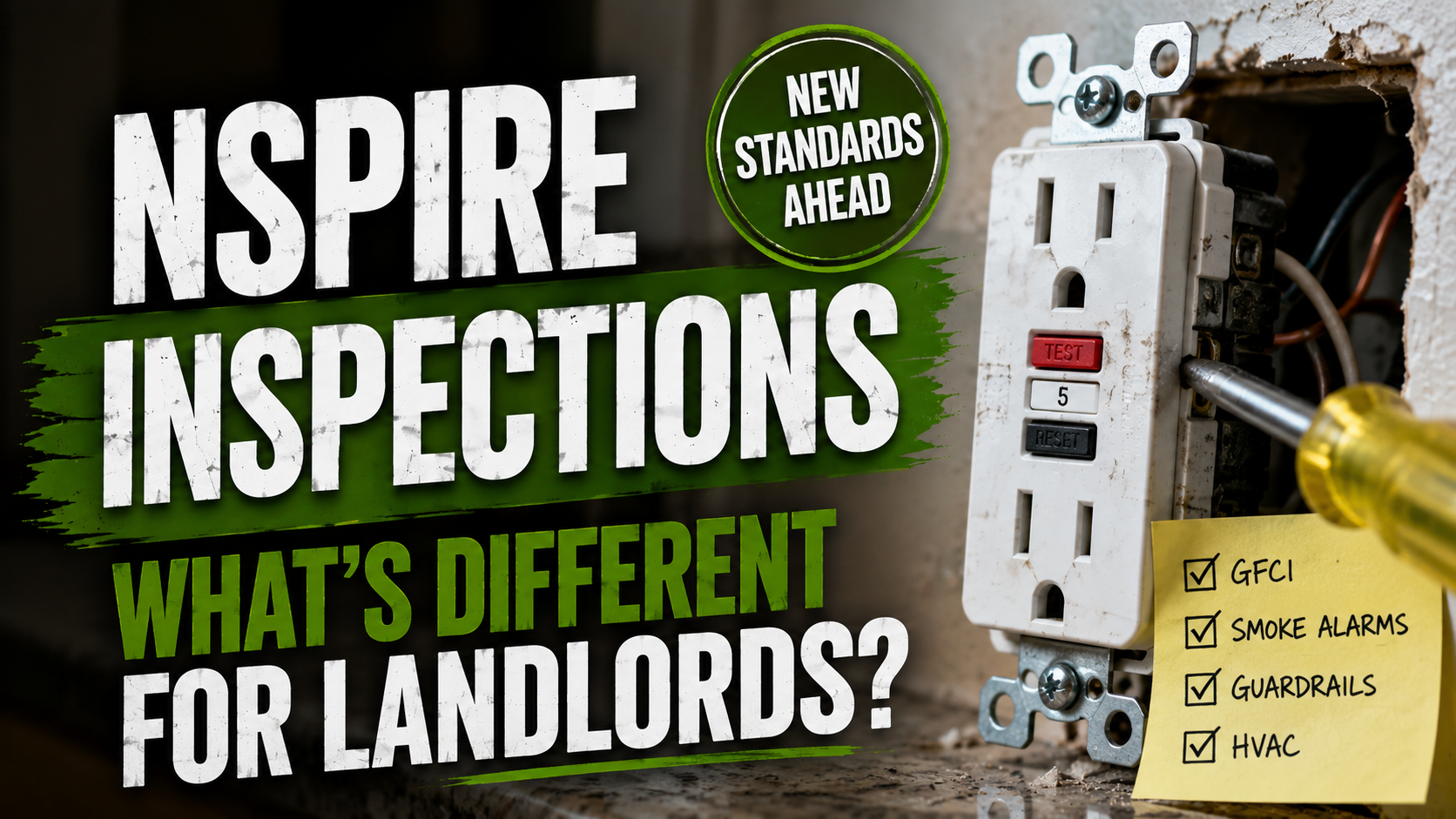
-As NSPIRE fully phases in, additional scored items get incorporated, including fire rated doors, GFCI and AFCI electrical protection, guardrails, HVAC condition, and interior lighting, items that weren't part of the older HQS checklist.
When Is This Actually Coming?
NSPIRE isn't new; it's just new to voucher programs. HUD began using it for Public Housing back in mid 2023, and for multifamily HUD-assisted properties starting October 1, 2023. Those rollouts are done.
The Housing Choice Voucher program is a different story. HUD has pushed back the compliance date for HCV, Project Based Voucher, and Moderate Rehabilitation programs three separate times since the rule was finalized. The current, and hopefully final, target is January 31, 2027. Until that date arrives, individual PHAs have the option to adopt NSPIRE for their voucher inspections early, or to keep running inspections under the familiar HQS rules. That means two landlords in two different suburbs could legitimately be inspected under two different standards right now, depending on what their local PHA has decided.
The practical move for any landlord holding voucher tenants: don't assume. Ask your PHA directly which standard currently governs your inspections, and ask again as 2027 approaches, since some PHAs will switch early and others will wait for the deadline.
FAQ
Does NSPIRE apply to my units right now? It depends on your PHA. Public Housing and multifamily HUD properties are already under NSPIRE. Housing Choice Voucher inspections are still allowed to run under the old HQS rules until January 31, 2027, unless your specific PHA has opted in early.
Is NSPIRE stricter than HQS? It's more detailed rather than simply stricter. HQS ran on a short, judgment based checklist. NSPIRE defines roughly 70 specific standards with published severity levels, which means less ambiguity but also more individual items an inspector can flag.
What happens if my unit fails an NSPIRE inspection? The deficiency gets a severity tier and a correction deadline, ranging from 24 hours for life threatening issues to 60 days for low severity items. Failing to correct within that window puts the HAP contract at risk.
Do I need to do anything before 2027? At minimum, confirm your smoke and carbon monoxide alarms already meet the statutory requirements, since those apply now regardless of NSPIRE's timeline. Beyond that, walking your units against the newer scored items (fire rated doors, GFCI/AFCI outlets, guardrails, HVAC condition, interior lighting) now will save you a scramble later.
Don't Go At This Alone!
Compliance deadlines like this one are exactly where self managing landlords get caught flat footed, not because the rules are secret, but because nobody's job is to track when they change. Our team at GC Realty & Development manages roughly 1,500 units across Chicago and over 100 suburbs for over 500 private investors, and staying ahead of HUD and Illinois compliance changes like NSPIRE is part of what we do every day so our owners don't have to.
I built this business because I believe owners deserve a management partner who operates like an investor first, not just a vendor collecting a fee. If you're holding voucher tenants and want a team that's already tracking what's coming, we're here for it.
Related reading: check out our breakdown of the Illinois Section 8 waiting list and how landlords benefit from accepting vouchers, and our guide to Illinois RLTO lease packet requirements for anything else you need locked down before you sign a lease.
%20(3)%20(1)_3.png)
_1.png)